Showing posts with label Asian film. Show all posts

Thursday, January 2, 2020

FILM REVIEW: KUNDUN


Martin Scorsese has always shown a deep reverence and appreciation for Asian cinema, as reflected in his championing of Asian auteurs like Edward Yang, Tian Zhuangzhuang, and Apichatpong Weerasethakul. Through his World Cinema Foundation, Scorsese has rescued and restored many important Asian films, including A Brighter Summer Day and The Housemaid. With Kundun (1997) Scorsese made his first Asian themed film, and the result is one of his emotionally resonant and moving films.

Kundun is a biopic about Tenzin Gyatso, the 14th Dalai Lama. The film explores the Dalai Lama’s life from his youth in Tibet up to his exile to India in 1959. Like Scorsese’s other spiritually themed films The Last Temptation of Christ and Silence, Kundun explores the topic of religious persecution. After the Communist government of China took over Tibet, atrocities against the Dalai Lama and his followers were committed, forcing the Dalai Lama to flee to India.

Throughout Kundun, Scorsese shows the struggles the Dalai Lama faced to maintain his practice of non-violent resistance. As the spiritual leader of his followers, the Dalai Lama has to protect his own people against the violent and oppressive actions of the Chinese invaders. Since the Dalai Lama obviously does not have access to a military or arms to defend himself, he tries at first to meet face to face with Mao Zedong to negotiate a peace deal.


This results in Mao furthering his prosecution of the Tibetan natives, and lecturing the Dalai Lama about how religion is poison. This is similar to the Japanese Inquisitor in Silence chastising Andrew Garfield’s Jesuit priest about how “the tree of Christianity withers in Japanese soil” because it has been poisoned. Indeed, both Kundun and Silence explore how peaceful protagonists confront and deal with oppressive, violent outside forces which view religion as something to be eliminated.

In a Scorsese gangster film, the protagonists naturally will counter violence with even more violent acts, resulting in a vicious circle of incessant death and destruction. Kundun is Scorsese’s first attempt to explore how one can fight violence with peaceful protest and compassion. Amidst the brutal oppression of his times, the Dalai Lama hopes that his example of compassionate resistance will result in peace.
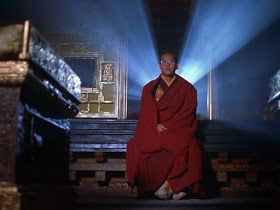

We never see explicit depictions of the violence committed against the Tibetan people, except for one brief vision by the Dalai Lama of the corpses of his fellow monks. Instead, Scorsese fills Kundun with quiet but visually astounding imagery inspired by Buddhist philosophy, such as a breathtaking scene of an elaborate sand mandala being created and blown away. Kundun is an almost ethnographic exploration of the Dalai Lama’s culture, as Scorsese faithfully depicts the many rituals and traditions of the Tibetan people.

Throughout the film, Scorsese emphasizes the fragility of the Dalai Lama’s peaceful existence. The film’s earlier, more elegiac scenes of the Dalai Lama’s youth contrast with the more disruptive, frantic scenes of the Chinese army and government gradually infiltrating Tibet, such as an astonishing scene of the Chinese army marching ominously through the streets. This temporal nature of existence is emphasized throughout Kundun, as Scorsese is showing how life itself is transitory, and so are violence and suffering.


The last act of Kundun, as the Dalai Lama escapes to India, is an almost wordless sequence of events that depicts both the tragedy and ultimate hope of the Dalai Lama’s life. Just as he is about to cross the border into safety, he speaks these haunting words, “I think I am a reflection, like the moon on water. When you see me, and I try to be a good man, you see yourself.” Following the example of these words by the Dalai Lama, Scorsese emphasizes images of peace instead of violence in Kundun in the hopes of reflecting human nature’s deeper good.


Saturday, November 9, 2019

FILM REVIEW: SHOPLIFTERS


Hirokazu Koreeda’s Shoplifters (2018) is a heartbreaking film about a loving yet dysfunctional family that has the emotional resonance and raw power of Italian neorealist classics like Bicycle Thieves and Bitter Rice. Like those films, Shoplifters takes an unflinching look at the lengths those living in poverty will go to survive. There is no easy resolution to the characters’ situations in Shoplifters, and Koreeda doesn’t shy away from showing how morally ambiguous at times his leads can be. By asking the audience to identify with characters whose actions can be criminal at times, Koreeda is forcing us to reckon with our value systems when it comes to our perceptions of what proper society should be like.

Shoplifters is the story of Osamu (Masaya Nakagawa) and his wife Nobuyo (Sakura Ando), the heads of a non-traditional family of outcasts from society. Osamu trains a young boy named Shota (Kairi Jo) to shoplift, which becomes their main source of sustenance. This surrogate family lives in a small shack that is owned by an elderly woman by the name of Hatsue (Karin Kiki), who survives off of her deceased husband’s pension. Also living with this family is Aki (Mayu Matsuoka), a young woman who works at a hostess club. After Osamu takes in a young girl one night to join the family, the existing fissures in this makeshift family begin to crack, culminating in a series of tragic occurrences.


By creating this eclectic family unit, Koreeda is asking us to consider what does a family mean? Although the family in Shoplifters is not wealthy and must struggle to get by, they are depicted in the first half of the film as being close-knit and happy with each other. Koreeda carefully weaves together intimate and touching scenes of this misfit family genuinely enjoying each other’s company, and expressing true love for one another.

Then, in the second half of the film, Koreeda pulls the rug out from under us, and forces us to question our perceptions about this family. Without giving anything away, the true nature of the family’s living arrangement is revealed, and the former veneer of domestic bliss is stripped away to reveal a more cynical and troubling reality. However, Koreeda carefully reveals how despite the questionable motivations for the formation of the family, what makes them a real family is the genuine love and strong bond they feel for each other.


Koreeda contrasts this family with the more cold and distant family of the girl they take in. Although the girl’s biological family is more prosperous,  there are hints that they are guilty of neglect and abuse towards her. Indeed, the innocence of the girl and the other child character in Shoplifters, Shota, form the moral compass of the film.

Although Shota is taught to shoplift by his surrogate father, he ultimately realizes the errors of his ways, and is the one who later forces the family to reconsider the legality of their lives. Like in his previous films, Koreeda uses youth as a metaphor for the optimism of the future, and as a counter example for the corruption of some members of older generations. Adults in Koreeda’s film are oftentimes depicted as being not aware of the needs and desires of their children, who are left to fend for themselves.


Just as bucolic and peaceful as the first half of Shoplifters is, the last act of the film is an emotionally devastating portrait of the surrogate family being torn apart. The emotional highlight of the film is an almost unbearably painful monologue by Nobuyo, as she tries to justify her actions and at the same time come to terms with her fate.

For Koreeda, the sins of the parents give way to an uncertain and yet hopeful future for the next generation. The makeshift family unit in Shoplifters was one filled with love and affection, and yet also shunned by the wider society which they had no chance of fitting into. Ultimately, Shoplifters is a plea for more compassion and understanding for those who exist on the margins of society.


Sunday, October 20, 2019

ANG LEE AND THE FUTURE OF CINEMA


Throughout his career, Ang Lee has made intimate films which dealt with family dysfunction. His earlier films Pushing Hands, Eat Drink Man Woman, and The Wedding Banquet examined inter-generational conflict between parents and their offspring, while his American films such as The Ice Storm and Brokeback Mountain explored how the nuclear family was threatened and disrupted by outside forces. What connected all these films together was Lee’s concern for exploring how the central family unit could survive in a rapidly changing society. Critics praised Lee for his work, and heralded him as a contemporary master of small-scale dramas.


Then, Lee surprised many with his embrace of large budget, effects heavy films that at first glance were completely different from his smaller, more intimate films. With Life of Pi, Lee used 3D and CGI technology to create an epic adventure film that veered into fantasy territory. Life of Pi received both commercial success and critical acclaim, and was celebrated as a visually extravagant adventure story. However, upon closer inspection, Life of Pi was also ultimately a film about the family unit; the central premise of the film was about how a close-knit family was torn apart by a tragic event which forever changed the life of the son.

With his subsequent films after Life of Pi, Lee further explored technological advances in cinema by experimenting with high frame rates. Lee filmed Billy Lynn’s Long Halftime Walk using 60 frames per second, resulting in a hyper realistic visual aesthetic. Then, with Gemini Man, Lee went even further and filmed in 120 frames per second. Although on the surface Billy Lynn’s Long Halftime Walk and Gemini Man seem to have nothing in common with Lee’s smaller films, they are further continuations of Lee’s exploration of the family.


In Billy Lynn’s Long Halftime Walk, Lee explores how the central character struggles to choose between his biological family and the new “family” he found in his Bravo Squad army unit, led by the surrogate father figures of Sergeant Breem and Sergeant Dime.  In Gemini Man, Will Smith’s character is a government assassin who never had a family of his own. He then discovers a surrogate family in the form of another agent by the name of Dani, who becomes his unofficial “wife,” and with the discovery of his younger cloned self, who becomes his “son.” It’s interesting to note how in both films, the main characters find their true families outside of their biological families.

Also, the central conflict in both films involves the protagonists trying to keep the bonds with their newfound family intact against outer forces which threaten to tear apart their surrogate family units.  Billy Lynn’s Long Halftime Walk is about how the media and American society keeps misinterpreting and wanting to take advantage of the “family unit” of the soldiers for their own purposes. Gemini Man is about Will Smith trying to prevent the government from separating him from his surrogate son in the form of his cloned self.

With the thematic consistency between Billy Lynn’s Long Halftime Walk and Gemini Man with Lee’s earlier critically acclaimed films, the question remains as to why these more recent films were so negatively received?  Much of the hostility towards these films can be explained by the technology that Lee used in these two films. High frame rate shooting is traditionally reserved for sporting events or live events such as concerts and awards ceremonies. The reason for this is because high frame rate visuals are very crisp and clear, and thus they make viewers feel more like they are a part of the event.


By applying this same “live” feel to the medium of narrative cinema, Lee is also attempting to make the viewer feel like they are actually experiencing what they are seeing on screen in real time. He wants to separate the usual distance which traditional 24 frames per second film creates for viewers, and instead make us feel like we are fully engulfed in the cinematic experience. Indeed, Billy Lynn’s Long Halftime Walk is set during an actual sporting event, and the Iraq war scenes feel like CNN live embeds. Lee is immersing us directly into the action of the film.

Traditionally, viewers of cinema want to feel like they are seeing a fictional recreation of real life; this is what 24 frames per second films accomplish by establishing a clear separation between the viewer and what they are seeing on screen. 24 frames per second creates a sheen of film movement and texture which is not like real life. Instead, it gives cinema the texture and feel of a separate, fictional realm of storytelling.

We have been cognitively trained through decades of film viewing to approach and see cinema in this manner. As a result, when we are forced out of our comfort zone and made to feel like we are no longer separated from the illusion of cinema, our natural reaction is discomfort and hostility. Hence, this explains the overwhelmingly negative reception for Billy Lynn’s Long Halftime Walk and Gemini Man.

On their own merits, both Billy Lynn’s Long Halftime Walk and Gemini Man are emotionally powerful and skillfully made explorations about the family unit.  It may take a long time for cinema viewers to embrace 120 frames per second filming, or perhaps they will never fully embrace it. However, all art forms evolve and I believe that a more hyper real form of cinema is the next major evolution in cinema. Silent films evolved into sound films, black and white films evolved into color films, and now we are in the digital evolution of filmmaking.

High frame rate was designed specifically for digital filmmaking, and Ang Lee is exploring how we as viewers and filmmakers can continue to see and make cinema which advances the evolution of digital technology.  Almost all aspects of our lives are becoming increasingly reliant on an online world that is based on a virtual, digital form of reality.  The next evolution in film is a plunge into this digital world through high frame rate technology; Ang Lee is just giving us the extra push to immerse ourselves in this brave new world.


Friday, November 16, 2012

FILM REVIEW: LIFE OF PI

Ang Lee has always been interested in exploring the conflict between our inner and outer desires, and how society oftentimes prevents us from revealing our true selves. 

Eat Drink Man Woman was about a woman who had to defer her dreams of being a professional chef in order to advance her career as a corporate executive and take care of her father.  The Ice Storm was about a whole family struggling with the traditional concept of the nuclear family and the more liberating sexual revolution of the 1970s.  Brokeback Mountain was about a married man living in a prejudiced society who had to repress his homosexuality. 

Now, with Life of Pi, Ang Lee has created his most powerful and complex film yet about how our innate needs and wishes can conflict with the wider society.


AngLeeFilm1


Life of Pi is based upon the Man Booker Prize winning novel of the same name by Yann Martel.  The film and book are about an Indian boy named Pi (played by Suraj Sharma as the young Pi, and Irrfan Khan as the adult Pi), who forms an unusual relationship with a tiger named Richard Parker.  After Pi survives a shipwreck, he is stranded in the ocean on a single lifeboat with Richard Parker, and he must learn how to live with and eventually gain the trust of the unpredictable tiger. 

From this simple story, Ang Lee creates a complex, multi-layered meditation on the nature of faith, compassion, and most importantly, the reconciliation of our inner desires with what society expects of us.  Life of Pi is told in flashbacks, as the adult Pi meets with a writer who wants to tell his story. 


AngLeeFilm2


The first part of Life of Pi deals with Pi’s journey to find God, as he moves from one religion to another.  At the same time, Pi’s spiritual journey keeps getting interrupted by his father, whose strict secular worldview conflicts with Pi’s more religious leanings. 

Pi’s father represents the wider society that Pi always finds himself competing with; in a world dominated by science and technology, how can someone as spiritually adventurous as Pi survive?  However, Pi is a headstrong individual, and he’s constantly getting in trouble with both his father and the society at large with his restless yearning to find deeper meaning in the world. 

Pi’s journey leads him to being adrift in a single lifeboat, where his worldview and very survival depend on how he deals with a carnivorous, dangerous tiger.  The tiger is symbolic of many things—it represents Pi’s own strong-willed, unyielding nature in the face of a society that won’t accept his beliefs, and it also is a stand-in for Pi’s father who, like the tiger, is both a figure of menace and threat, and also of immense compassion.


AngLeeFilm3


With the many visually astonishing scenes of Pi and the tiger framed against the vastness of the ocean, one gets the sense that there is a higher force at work, watching over Pi and guiding him in his journey of survival.  For the more religiously inclined, this force can be described as being God, but Ang Lee takes this concept further by suggesting that God is more than just a single, all-powerful figure. 

Instead, Ang Lee suggests that God is nature itself, as revealed in an astonishing sequence where Pi and the tiger find themselves on a lush island.  The island is a bountiful source of nutrients and fresh water for Pi and the tiger to live off of, but at the same time Pi discovers that the island also contains a more dangerous side which can lead to death.  Ang Lee is equating nature in the form of the island with God—both forces have the power to give and take away.

In purely cinematic terms, Life of Pi contains some of the most visually ravishing scenes in film history.  The aforementioned scenes on the island re-awaken a sense of wonder and amazement that has been missing in many of the more cynically inclined films of recent years.  Ang Lee uses 3D to astonishing effect in the many awe-inspiring scenes of Pi and the tiger as they encounter the variety of life that exists in the vastness of the ocean. 


AngLeeFilm4


Instead of using 3D to thrill the audience with cheap effects such as creatures popping out of the screen, Ang Lee is more interested in using the medium to engulf the viewer in what can best be called a communal re-connection with nature.  In one particularly effective scene, we see Pi and his lifeboat appearing as little more than a dot against the expansive ocean at night; the ocean waters reflect all the stars above, so it looks like Pi is floating through the vastness of space.

However, unlike some other recent 3D films, Ang Lee doesn’t let the technical spectacle of his film overwhelm the more intimate and philosophical aspects.  Life of Pi isn’t just about visual splendor and 3D effects; instead, it is a deep meditation on life and death, and our ultimate place in the universe. 

Monday, October 1, 2012

FILM REVIEW: NIGHT AND DAY

The Korean filmmaker Hong Sang-soo has always been influenced by the works of French New Wave director Eric Rohmer, so it’s only fitting that he would eventually make a film set in France.  That film turned out to be 2008’s Night and Day, a brilliant and witty comedy of manners.
Night and Day takes the European feel of his Korean set films and places them in Paris, which was the setting for many seminal films from the French New Wave era, such as Suzanne’s Career, Masculin Feminin, and The Mother and the Whore.  Like these films, Night and Day is a nuanced and cerebral film that contains long, extended shots of dialogue set among the cafes and apartments of Paris.  Indeed, the city of Paris becomes a third character in the film, one which both constrains and liberates the central characters.

NightAndDay1


Night and Day is about Seong-nam (Kim Yeong-ho), a middle-aged, married painter living in Korea who gets in trouble with the law when he is caught smoking marijuana.  He flees Korea to live in a hostel in Paris, where he meets and falls in love with Yu-jeong (Park Eun-hye), an attractive, much younger art student.  A moral dilemma ensues as Seong-nam finds himself steadily more obsessed with Yu-jeong, while trying to remain faithful to his wife, whom he calls every night. 
Unlike the more romantic version of Paris portrayed in American films like Midnight In Paris and Henry and June, Night and Day presents a more realistic and grounded portrait of the French city.  Hong Sang-soo is more interested in exploring the everyday, mundane life of Paris, carefully observing Parisians in the park exercising or buying medicine at a drugstore, than in presenting an overly sentimentalized portrait of Paris as a city filled with bright lights and romantic encounters. 
Night and Day was Hong Sang-soo's first film shot in digital video as opposed to film, creating a more documentary-like look.  This resulted in the more naturalistic tone of Paris that Hong Sang-soo was going for.

NightAndDay2


The only time we see anything close to the cliché of Paris as a city of lovers is when Hong Sang-soo films a Parisian couple on a bench kissing, but this scene is shot from a distance and in the dull brightness of the day, removing the scene from any romantic connotations. 
Indeed, virtually all the outdoor scenes of Paris are shot during the daytime, giving the film a more prosaic view of the Paris streets.  Hong Sang-soo further distances himself from shooting the City of Lights during the more romantic nighttime when a character tells Seong-nam that it is difficult to distinguish night from day during the summertime, due to the long duration of the days. 
This inability to tell night from day also symbolizes the disconnect that Seong-nam feels as an expatriate living in a foreign country.  Not only is he separated from his wife in Paris, he also becomes separated from his desires in his pursuit of what he realizes is an unobtainable woman.  The art student that he chases, Yu-jeong, even tells him at one point that she cannot have a relationship with him due to his marital status.  Paris is no longer a mythical city where romance blooms for Seong-nam; instead it has become an emotional prison.

NightAndDay3

Thus, Hong Sang-soo is not only demystifying the overly romanticized portrait of Paris which so often occurs in American films.  He is also revealing the futility and messiness of relationships, where love is possible, but not without real-life consequences and emotional turmoil.  This deromanticization of love is a topic that Eric Rohmer also explored, most famously in his “Six Moral Tales” films. 
Both Rohmer and Hong Sang-soo use film as a means of portraying male/female relationships in a more realistic manner.  They know that oftentimes the desires of men do not match those of women, and vice versa.  This central fallacy of love leads more often to heartbreak and misunderstanding than eternal bliss, as portrayed in Hollywood romantic films. 
Night and Day is like an existential version of the Hollywood classic An American in Paris, minus its lavish musical numbers and brightly lit shots of Paris.  Indeed, by making his main character a painter and a foreigner in Paris, Hong Sang-soo seems to be paying tribute to the similar struggling painter and expatriate in An American in Paris.  In place of music numbers, Night and Day has long, clever scenes of dialogue, which at times feel like music numbers themselves with their elaborate back and forth banter, and inventive wordplay.  In place of the ebullient Gene Kelly, Night and Day has a brooding, emotionally awkward protagonist. 
The post-modern cinematic simulacrum has come full-circle—French New Wave filmmakers paid tribute to classic Hollywood films, Hong Sang-soo and other members of the Asia New Wave paid tribute to French New Wave filmmakers, and now Hong Sang-soo is paying tribute back to Hollywood classics. 
While the Korean character in Night and Day doesn’t quite fit in with his new Parisian surroundings, Hong Sang-soo’s filmmaking style is a perfect match for his new French setting.  Like French New Wave pioneers such as Eric Rohmer and Jean Luc Godard, Hong Sang-soo is able to make a film in Paris which doesn’t gloss over and overly romanticize the mythical city. 
Instead, like his European counterparts, Hong Sang-soo has made a sophisticated, intelligent film that presents a well-rounded and realistic portrayal of the eternal emotional dance between men and women. 

NightAndDay4

Wednesday, September 26, 2012

FILM REVIEW: SUMMER PALACE

Lou Ye is one of the most controversial filmmakers from mainland China.  His films deal with topics that are taboo to portray in Chinese films—homosexuality, political radicalism, and, most of all, the realistic portrayal of sex.  The latter two of these forbidden subject matters are covered in Lou Ye’s 2006 film Summer Palace, and the topic of same sex relationships is portrayed in Lou Ye’s 2009 film Spring Fever, which won the Prix du scenario award at the Cannes Film Festival.  As a result of Summer Palace’s politically tinged portrayal of the Tiananmen Square protests, Lou Ye was banned from filmmaking in China for five years.

SummerPalace1

Like Philip Kaufman’s The Unbearable Lightness of Being, Lou Ye’s Summer’s Palace is an incisive and heartbreaking portrait of how the hopes and dreams of an entire generation were shattered by a major political event.  The Tiananmen Square protests of 1989 were a mass protest of Chinese college students against the government to advocate for democracy.  The protests ended with a military backed crackdown by the government, which led to the deaths of many students. 
Although it does deal with the events at Tiananmen Square, Summer Palace is more of a personal story about a woman’s growth in China from the late 1980s through the 1990s.  The story follows Yu Hong (played by Hao Lei), a troubled young woman who experiments with sexual and political liberation as a student at the prestigious Beijing University.  While in college, she meets and falls in love with Zhou Wei (played by Guo Xiaodong), who becomes her college boyfriend and lifelong love interest.  She also befriends Li Ti (played by Hu Lingling), a free thinking woman. 
There is a clear divide in Summer Palace between the college years, which are portrayed in a romantic, optimistic light, and the years after the Tiananmen Square protests, an event which seems to shatter Chinese society and also the lives of three central characters.  Many of the scenes during the college years are shot against the warm glow of the sun or filtered through a bright haze, symbolizing the idealism and promise of youth. 

SummerPalace4
SummerPalace2


These early scenes are all about Yu Hong liberating herself from societal boundaries.  Her friend Li Ti introduces her to the pleasures of smoking and drinking.  She talks politics with her friends, discussing the possibility of a democratic society free from government restraints.  She falls in love with and has a brief, but passionate sexual relationship with Zhou Wei. 
However, at the same time that Yu Hong is attempting to experience a fully liberated life, we discover through the many interior monologue scenes that she ultimately feels a deep sense of existential dread and isolation from the world at large. 
This inescapable sense of alienation culminates in Yu Hong dropping out of college, both as a result of her participation in the ill-fated Tiananmen Square protests, and her increased dissatisfaction with her relationship with Zhou Wei. 
After the Tiananmen Square protests, the scenes in Summer Palace are filmed in a colder, harsher light.  The three main characters drift apart and continuously struggle to find ways to connect with themselves and others.  Li Ti and Zhou Wei consummate a relationship with each other, and end up moving together to Germany, where their relationship starts to deteriorate.  Yu Hong has problems fitting in with the wider society, both at work and in her personal life.  The idealism of youth and the promise for a bright future have been shattered. 

SummerPalace6


Lou Ye is portraying an entire generation that feels lost and adrift, one which cannot satisfactorily fit into the expected roles of marriage, love, and career.  He seems to imply that this generational malaise was always inherent within Chinese society, but it didn’t take root until the disastrous Tiananmen Square protests.
Although Lou Ye did have a script for Summer Palace, he used it mostly as a reference point for most of the filming.  Like Jean Luc-Godard and his contemporaries during the French New Wave era, Lou Ye abandoned the traditional constraints of the written script, and gave his actors the freedom to improvise and come up with their own lines and interactions. 
As a result, the acting in Summer Palace feels naturalistic and authentic, free from the artificiality and theatricality of more method approaches to acting.  This filmmaking technique reflects the central theme of Summer Palace—that of the liberating power of a life lived away from restraints and constricting rules. 
Indeed, the only post-Tiananmen Square scene in the film in which any of the characters reveal contentment occurs when Li Ti and Zhou Wei are casually walking through a square in Berlin, watching street performers, vagabonds, and various other outcasts from society freely expressing themselves. 


Monday, September 17, 2012

FILM REVIEW: THE SHOCK LABYRINTH

There are interesting differences between Asian horror films in terms of their countries of origin.  Korean horror films tend to be more realistic and straightforward in tone, and focus more on real life thrills, such as serial killer/detective plots (I Saw the Devil, Tell Me Something).  This can be attributed to Korean films being more mainstream in tone, as the Korean film industry is trying to establish a new Hollywood of sorts in the East, and want to make films that can compete with Hollywood on the global film market.


ISawTheDevil


Southeast Asian horror films tend to focus on the supernatural realm, with films dealing with ghosts and hauntings (Shutter, Ghost of Mae Nak).  This focus on the more supernatural realm of horror films can be attributed to the highly spiritual nature of Southeast Asian society; in many parts of Southeast Asia, such as Thailand and Indonesia, the realm of ghosts and spirits is intricately linked with the mundane realm of the real world. 


Shutter

 
Japanese horror films, on the other hand, are the most eccentric and original of all Asian horror films, as they frequently delve into the realm of the surreal and the absurd.  This may be attributed to the very strict and disciplined nature of Japanese society, in which life is based on a series of orderly and long-engrained traditions of rules and rituals.  Thus, the arts are a means of escaping from the rigid confines of Japanese society, and into a liberating realm of free-flowing creativity and taboo breaking, sometimes shocking displays of defiance.

The 2009 Japanese horror film The Shock Labyrinth is a perfect example of this rebellious, surreal aspect of Japanese arts.  Directed by the prolific and successful Takashi Shimizu, best known for the Ju-on series of horror films, The Shock Labyrinth is a bold and chilling film.  The Shock Labyrinth is reminiscent of the cult classic Japanese film Hausu, which was re-released by The Criterion Collection in 2010.  Like Hausu, The Shock Labyrinth is a genre bending film that takes the horror film trope about a group of youth who find themselves in a haunted house, and elevates it to a surreal and outrageous level. 

TheShockLabyrinth

The Shock Labyrinth begins with a group of young friends who mysteriously encounter Yuki, a long lost friend who they thought had been dead for a long time.  As the friends begin to question the true identity of Yuki, and some start to question their own sanity, Yuki has an accident, and they are forced to drive her to a hospital.  The only hospital they find turns out to be deserted, and as they explore the hospital, dark, hidden secrets from the friends’ childhood start to emerge.


TheShockLabyrinth3 

Like the Overlook Hotel in Stanley Kubrick’s The Shining, the hospital in The Shock Labyrinth starts to take on an identity by itself, as it taps into the subconscious of each of the friends to dig up repressed memories of a tragic event that occurred in their collective childhood experience.  As the title implies, the narrative of The Shock Labyrinth becomes labyrinthian in nature, as it weaves back and forth between violent and haunting memories of each of the main characters.  The dark and frightening rooms and tunnels in the hospital become direct reflections of the primal fears of each character, and as the true identity of Yuki gradually reveals itself, the characters one by one descend into madness.

Shimizu does a great job of throwing the audience into emotional turmoil, as his narrative gradually fragments into seemingly disconnected scenes of disturbing violence and bloodshed.  Upon repeated viewings, the fragmentary scenes of the narrative gradually reveal themselves to be intricately connected, like a giant puzzle which can only be solved by the more patient and discerning players.  What Shimizu is doing is cinematically portraying the true nature of a nightmare—how the seemingly random nature of our dreaming world has its own internal logic, one based upon the deeper matrix of the collective subconscious.

By gradually revealing more and more about the mystery of Yuki, Shimizu is also revealing the true nature of repressed memories.  Oftentimes when a traumatic event occurs, our mind tends to repress memories of this event.  These memories only come out when we are presented with a triggering mechanism to conjure them up.  The triggering mechanism in The Shock Labyrinth is the hospital itself, which becomes a living, breathing monster that threatens to swallow up all of the main characters. 

The Shock Labyrinth is a brilliant and frightening film that takes us on a wild ride into the realm of nightmares.  Its narrative structure is psychologically sophisticated, and by the end of the film, the viewer is stuck in the deepest, darkest realms of the character’s horrific memories.


TheShockLabyrinth1