A blog from me, Jeffrey Wang, about Asian film and culture, as well as discussions of films from throughout the world. I am an Asian-American filmmaker and writer. Please check out my books for sale at Amazon at this link: CLICK HERE
Showing posts with label Chinese Film. Show all posts
Thursday, January 2, 2020
FILM REVIEW: KUNDUN
Martin Scorsese has always shown a deep reverence and appreciation for Asian cinema, as reflected in his championing of Asian auteurs like Edward Yang, Tian Zhuangzhuang, and Apichatpong Weerasethakul. Through his World Cinema Foundation, Scorsese has rescued and restored many important Asian films, including A Brighter Summer Day and The Housemaid. With Kundun (1997) Scorsese made his first Asian themed film, and the result is one of his emotionally resonant and moving films.
Kundun is a biopic about Tenzin Gyatso, the 14th Dalai Lama. The film explores the Dalai Lama’s life from his youth in Tibet up to his exile to India in 1959. Like Scorsese’s other spiritually themed films The Last Temptation of Christ and Silence, Kundun explores the topic of religious persecution. After the Communist government of China took over Tibet, atrocities against the Dalai Lama and his followers were committed, forcing the Dalai Lama to flee to India.
Throughout Kundun, Scorsese shows the struggles the Dalai Lama faced to maintain his practice of non-violent resistance. As the spiritual leader of his followers, the Dalai Lama has to protect his own people against the violent and oppressive actions of the Chinese invaders. Since the Dalai Lama obviously does not have access to a military or arms to defend himself, he tries at first to meet face to face with Mao Zedong to negotiate a peace deal.
This results in Mao furthering his prosecution of the Tibetan natives, and lecturing the Dalai Lama about how religion is poison. This is similar to the Japanese Inquisitor in Silence chastising Andrew Garfield’s Jesuit priest about how “the tree of Christianity withers in Japanese soil” because it has been poisoned. Indeed, both Kundun and Silence explore how peaceful protagonists confront and deal with oppressive, violent outside forces which view religion as something to be eliminated.
In a Scorsese gangster film, the protagonists naturally will counter violence with even more violent acts, resulting in a vicious circle of incessant death and destruction. Kundun is Scorsese’s first attempt to explore how one can fight violence with peaceful protest and compassion. Amidst the brutal oppression of his times, the Dalai Lama hopes that his example of compassionate resistance will result in peace.
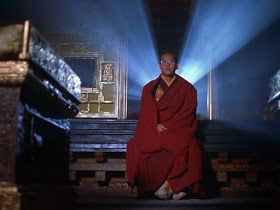
We never see explicit depictions of the violence committed against the Tibetan people, except for one brief vision by the Dalai Lama of the corpses of his fellow monks. Instead, Scorsese fills Kundun with quiet but visually astounding imagery inspired by Buddhist philosophy, such as a breathtaking scene of an elaborate sand mandala being created and blown away. Kundun is an almost ethnographic exploration of the Dalai Lama’s culture, as Scorsese faithfully depicts the many rituals and traditions of the Tibetan people.
Throughout the film, Scorsese emphasizes the fragility of the Dalai Lama’s peaceful existence. The film’s earlier, more elegiac scenes of the Dalai Lama’s youth contrast with the more disruptive, frantic scenes of the Chinese army and government gradually infiltrating Tibet, such as an astonishing scene of the Chinese army marching ominously through the streets. This temporal nature of existence is emphasized throughout Kundun, as Scorsese is showing how life itself is transitory, and so are violence and suffering.
The last act of Kundun, as the Dalai Lama escapes to India, is an almost wordless sequence of events that depicts both the tragedy and ultimate hope of the Dalai Lama’s life. Just as he is about to cross the border into safety, he speaks these haunting words, “I think I am a reflection, like the moon on water. When you see me, and I try to be a good man, you see yourself.” Following the example of these words by the Dalai Lama, Scorsese emphasizes images of peace instead of violence in Kundun in the hopes of reflecting human nature’s deeper good.
Sunday, October 20, 2019
ANG LEE AND THE FUTURE OF CINEMA
Throughout his career, Ang Lee has made intimate films which dealt with family dysfunction. His earlier films Pushing Hands, Eat Drink Man Woman, and The Wedding Banquet examined inter-generational conflict between parents and their offspring, while his American films such as The Ice Storm and Brokeback Mountain explored how the nuclear family was threatened and disrupted by outside forces. What connected all these films together was Lee’s concern for exploring how the central family unit could survive in a rapidly changing society. Critics praised Lee for his work, and heralded him as a contemporary master of small-scale dramas.
Then, Lee surprised many with his embrace of large budget, effects heavy films that at first glance were completely different from his smaller, more intimate films. With Life of Pi, Lee used 3D and CGI technology to create an epic adventure film that veered into fantasy territory. Life of Pi received both commercial success and critical acclaim, and was celebrated as a visually extravagant adventure story. However, upon closer inspection, Life of Pi was also ultimately a film about the family unit; the central premise of the film was about how a close-knit family was torn apart by a tragic event which forever changed the life of the son.
With his subsequent films after Life of Pi, Lee further explored technological advances in cinema by experimenting with high frame rates. Lee filmed Billy Lynn’s Long Halftime Walk using 60 frames per second, resulting in a hyper realistic visual aesthetic. Then, with Gemini Man, Lee went even further and filmed in 120 frames per second. Although on the surface Billy Lynn’s Long Halftime Walk and Gemini Man seem to have nothing in common with Lee’s smaller films, they are further continuations of Lee’s exploration of the family.
In Billy Lynn’s Long Halftime Walk, Lee explores how the central character struggles to choose between his biological family and the new “family” he found in his Bravo Squad army unit, led by the surrogate father figures of Sergeant Breem and Sergeant Dime. In Gemini Man, Will Smith’s character is a government assassin who never had a family of his own. He then discovers a surrogate family in the form of another agent by the name of Dani, who becomes his unofficial “wife,” and with the discovery of his younger cloned self, who becomes his “son.” It’s interesting to note how in both films, the main characters find their true families outside of their biological families.
Also, the central conflict in both films involves the protagonists trying to keep the bonds with their newfound family intact against outer forces which threaten to tear apart their surrogate family units. Billy Lynn’s Long Halftime Walk is about how the media and American society keeps misinterpreting and wanting to take advantage of the “family unit” of the soldiers for their own purposes. Gemini Man is about Will Smith trying to prevent the government from separating him from his surrogate son in the form of his cloned self.
With the thematic consistency between Billy Lynn’s Long Halftime Walk and Gemini Man with Lee’s earlier critically acclaimed films, the question remains as to why these more recent films were so negatively received? Much of the hostility towards these films can be explained by the technology that Lee used in these two films. High frame rate shooting is traditionally reserved for sporting events or live events such as concerts and awards ceremonies. The reason for this is because high frame rate visuals are very crisp and clear, and thus they make viewers feel more like they are a part of the event.
By applying this same “live” feel to the medium of narrative cinema, Lee is also attempting to make the viewer feel like they are actually experiencing what they are seeing on screen in real time. He wants to separate the usual distance which traditional 24 frames per second film creates for viewers, and instead make us feel like we are fully engulfed in the cinematic experience. Indeed, Billy Lynn’s Long Halftime Walk is set during an actual sporting event, and the Iraq war scenes feel like CNN live embeds. Lee is immersing us directly into the action of the film.
Traditionally, viewers of cinema want to feel like they are seeing a fictional recreation of real life; this is what 24 frames per second films accomplish by establishing a clear separation between the viewer and what they are seeing on screen. 24 frames per second creates a sheen of film movement and texture which is not like real life. Instead, it gives cinema the texture and feel of a separate, fictional realm of storytelling.
We have been cognitively trained through decades of film viewing to approach and see cinema in this manner. As a result, when we are forced out of our comfort zone and made to feel like we are no longer separated from the illusion of cinema, our natural reaction is discomfort and hostility. Hence, this explains the overwhelmingly negative reception for Billy Lynn’s Long Halftime Walk and Gemini Man.
On their own merits, both Billy Lynn’s Long Halftime Walk and Gemini Man are emotionally powerful and skillfully made explorations about the family unit. It may take a long time for cinema viewers to embrace 120 frames per second filming, or perhaps they will never fully embrace it. However, all art forms evolve and I believe that a more hyper real form of cinema is the next major evolution in cinema. Silent films evolved into sound films, black and white films evolved into color films, and now we are in the digital evolution of filmmaking.
High frame rate was designed specifically for digital filmmaking, and Ang Lee is exploring how we as viewers and filmmakers can continue to see and make cinema which advances the evolution of digital technology. Almost all aspects of our lives are becoming increasingly reliant on an online world that is based on a virtual, digital form of reality. The next evolution in film is a plunge into this digital world through high frame rate technology; Ang Lee is just giving us the extra push to immerse ourselves in this brave new world.
Wednesday, September 26, 2012
FILM REVIEW: SUMMER PALACE
Lou Ye is one of the most controversial filmmakers from mainland China. His films deal with topics that are taboo to portray in Chinese films—homosexuality, political radicalism, and, most of all, the realistic portrayal of sex. The latter two of these forbidden subject matters are covered in Lou Ye’s 2006 film Summer Palace, and the topic of same sex relationships is portrayed in Lou Ye’s 2009 film Spring Fever, which won the Prix du scenario award at the Cannes Film Festival. As a result of Summer Palace’s politically tinged portrayal of the Tiananmen Square protests, Lou Ye was banned from filmmaking in China for five years.
Like Philip Kaufman’s The Unbearable Lightness of Being, Lou Ye’s Summer’s Palace is an incisive and heartbreaking portrait of how the hopes and dreams of an entire generation were shattered by a major political event. The Tiananmen Square protests of 1989 were a mass protest of Chinese college students against the government to advocate for democracy. The protests ended with a military backed crackdown by the government, which led to the deaths of many students.
Although it does deal with the events at Tiananmen Square, Summer Palace is more of a personal story about a woman’s growth in China from the late 1980s through the 1990s. The story follows Yu Hong (played by Hao Lei), a troubled young woman who experiments with sexual and political liberation as a student at the prestigious Beijing University. While in college, she meets and falls in love with Zhou Wei (played by Guo Xiaodong), who becomes her college boyfriend and lifelong love interest. She also befriends Li Ti (played by Hu Lingling), a free thinking woman.
There is a clear divide in Summer Palace between the college years, which are portrayed in a romantic, optimistic light, and the years after the Tiananmen Square protests, an event which seems to shatter Chinese society and also the lives of three central characters. Many of the scenes during the college years are shot against the warm glow of the sun or filtered through a bright haze, symbolizing the idealism and promise of youth.
These early scenes are all about Yu Hong liberating herself from societal boundaries. Her friend Li Ti introduces her to the pleasures of smoking and drinking. She talks politics with her friends, discussing the possibility of a democratic society free from government restraints. She falls in love with and has a brief, but passionate sexual relationship with Zhou Wei.
However, at the same time that Yu Hong is attempting to experience a fully liberated life, we discover through the many interior monologue scenes that she ultimately feels a deep sense of existential dread and isolation from the world at large.
This inescapable sense of alienation culminates in Yu Hong dropping out of college, both as a result of her participation in the ill-fated Tiananmen Square protests, and her increased dissatisfaction with her relationship with Zhou Wei.
After the Tiananmen Square protests, the scenes in Summer Palace are filmed in a colder, harsher light. The three main characters drift apart and continuously struggle to find ways to connect with themselves and others. Li Ti and Zhou Wei consummate a relationship with each other, and end up moving together to Germany, where their relationship starts to deteriorate. Yu Hong has problems fitting in with the wider society, both at work and in her personal life. The idealism of youth and the promise for a bright future have been shattered.
Lou Ye is portraying an entire generation that feels lost and adrift, one which cannot satisfactorily fit into the expected roles of marriage, love, and career. He seems to imply that this generational malaise was always inherent within Chinese society, but it didn’t take root until the disastrous Tiananmen Square protests.
Although Lou Ye did have a script for Summer Palace, he used it mostly as a reference point for most of the filming. Like Jean Luc-Godard and his contemporaries during the French New Wave era, Lou Ye abandoned the traditional constraints of the written script, and gave his actors the freedom to improvise and come up with their own lines and interactions.
As a result, the acting in Summer Palace feels naturalistic and authentic, free from the artificiality and theatricality of more method approaches to acting. This filmmaking technique reflects the central theme of Summer Palace—that of the liberating power of a life lived away from restraints and constricting rules.
Indeed, the only post-Tiananmen Square scene in the film in which any of the characters reveal contentment occurs when Li Ti and Zhou Wei are casually walking through a square in Berlin, watching street performers, vagabonds, and various other outcasts from society freely expressing themselves.
Subscribe to:
Posts (Atom)


