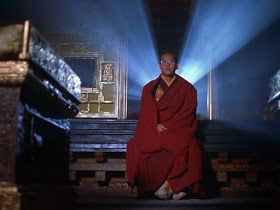
Martin Scorsese has always shown a deep reverence and appreciation for Asian cinema, as reflected in his championing of Asian auteurs like Edward Yang, Tian Zhuangzhuang, and Apichatpong Weerasethakul. Through his World Cinema Foundation, Scorsese has rescued and restored many important Asian films, including A Brighter Summer Day and The Housemaid. With Kundun (1997) Scorsese made his first Asian themed film, and the result is one of his emotionally resonant and moving films.
Kundun is a biopic about Tenzin Gyatso, the 14th Dalai Lama. The film explores the Dalai Lama’s life from his youth in Tibet up to his exile to India in 1959. Like Scorsese’s other spiritually themed films The Last Temptation of Christ and Silence, Kundun explores the topic of religious persecution. After the Communist government of China took over Tibet, atrocities against the Dalai Lama and his followers were committed, forcing the Dalai Lama to flee to India.
Throughout Kundun, Scorsese shows the struggles the Dalai Lama faced to maintain his practice of non-violent resistance. As the spiritual leader of his followers, the Dalai Lama has to protect his own people against the violent and oppressive actions of the Chinese invaders. Since the Dalai Lama obviously does not have access to a military or arms to defend himself, he tries at first to meet face to face with Mao Zedong to negotiate a peace deal.

This results in Mao furthering his prosecution of the Tibetan natives, and lecturing the Dalai Lama about how religion is poison. This is similar to the Japanese Inquisitor in Silence chastising Andrew Garfield’s Jesuit priest about how “the tree of Christianity withers in Japanese soil” because it has been poisoned. Indeed, both Kundun and Silence explore how peaceful protagonists confront and deal with oppressive, violent outside forces which view religion as something to be eliminated.
In a Scorsese gangster film, the protagonists naturally will counter violence with even more violent acts, resulting in a vicious circle of incessant death and destruction. Kundun is Scorsese’s first attempt to explore how one can fight violence with peaceful protest and compassion. Amidst the brutal oppression of his times, the Dalai Lama hopes that his example of compassionate resistance will result in peace.

We never see explicit depictions of the violence committed against the Tibetan people, except for one brief vision by the Dalai Lama of the corpses of his fellow monks. Instead, Scorsese fills Kundun with quiet but visually astounding imagery inspired by Buddhist philosophy, such as a breathtaking scene of an elaborate sand mandala being created and blown away. Kundun is an almost ethnographic exploration of the Dalai Lama’s culture, as Scorsese faithfully depicts the many rituals and traditions of the Tibetan people.
Throughout the film, Scorsese emphasizes the fragility of the Dalai Lama’s peaceful existence. The film’s earlier, more elegiac scenes of the Dalai Lama’s youth contrast with the more disruptive, frantic scenes of the Chinese army and government gradually infiltrating Tibet, such as an astonishing scene of the Chinese army marching ominously through the streets. This temporal nature of existence is emphasized throughout Kundun, as Scorsese is showing how life itself is transitory, and so are violence and suffering.

The last act of Kundun, as the Dalai Lama escapes to India, is an almost wordless sequence of events that depicts both the tragedy and ultimate hope of the Dalai Lama’s life. Just as he is about to cross the border into safety, he speaks these haunting words, “I think I am a reflection, like the moon on water. When you see me, and I try to be a good man, you see yourself.” Following the example of these words by the Dalai Lama, Scorsese emphasizes images of peace instead of violence in Kundun in the hopes of reflecting human nature’s deeper good.

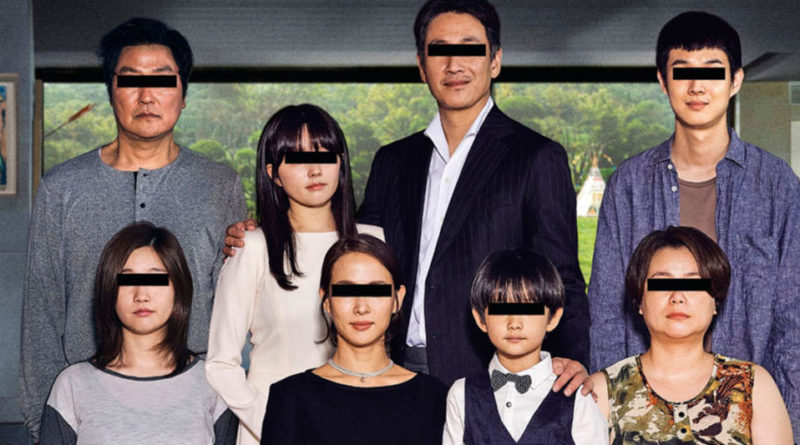
Bong Joon-ho’s Parasite (2019) is like the wild and crazy evil twin of Hirokazu Koreeda’s Shoplifters. While both films deal with a family in poverty who resort to extreme measures to survive, their cinematic methods are polar opposites. While Shoplifters is a quiet and subtle film, Parasite is a rapidly paced and boisterous dark comedy/thriller. Koreeda makes more introspective arthouse family dramas, while Joon-ho is a practitioner of more audience friendly genre films; this is reflected in the drastically different approaches to the topic of class inequality in Parasite and Shoplifters.
Parasite is about a financially struggling family of con artists who infiltrate themselves into the lives of a wealthy family. Joon-ho’s regular leading man Song Kang-ho plays Kim Ki-taek, the father of the con artists, while Jang Hye-jin, Park So-dam, and Choi Woo-shik play the mother, daughter, and son, respectively. Lee Sun-kyun and Cho Yeo-jeong play Park Dong-ik and Choi Yeon-gyo respectively, the easily manipulated father and mother of the wealthy family. Parasite is best enjoyed with less revealed about the plot details, but it is essentially about a power struggle between the con artist Ki-taek family and the prosperous Dong-ik family.

In a way, Parasite is like Luis Bunuel’s parodies of class warfare as directed by Quentin Tarantino, as it mixes social commentary with homages to popular genre tropes and scenes of almost cartoonish violence. This is both a strength of the film and a drawback, as Joon-ho’s attempts at creating a deeper social examination of class inequality are not as well executed as his action/suspense set pieces. As expertly crafted as the thriller and suspense aspects of Parasite are, where it falls short on are its attempts at social criticism and character development.
The characters in Parasite, from the destitute yet noble Kim Ki-tek to the wealthy but elitist Park Dong-ik and Choi Yeon-gyo, never reach anything beyond one dimensional caricatures. Also, the social critique and analysis of class warfare never penetrates deeper than surface level generalities of the wealthy taking advantage of those less fortunate than them. Parasite aspires to be both a mass entertainment thriller, while at the same time being an examination of societal divisions, but it doesn’t offer a more nuanced portrayal of this issue as Koreeda’s Shoplifters did.

Joon-ho wants us to feel justified outrage for the crass materialism and insensitivity of the wealthy class, but he does so in an overly obvious and heavy-handed manner. We see scenes of the Dong-ik family wallowing in their material wealth and looking down upon those outside their class, but everything in Parasite is portrayed in a black and white good versus evil level, without any shades of grey or ambiguity. In addition, because Joon-ho didn’t take the time to develop his performances beyond caricatures, we don’t have enough emotional investment to care about the characters for the last act of the film to work effectively. Instead, the conclusion of Parasite, which takes a turn into soap-operish drama, feels long and drawn out and wallows in sentimentality.
With that being said, where Parasite excels at is Joon-ho’s masterful handling of action and suspense scenes. As revealed in his previous films, Joon-ho is an expert at creating tension in elaborately designed set pieces; he does so through ingenious staging of the actors and their movement relative to camera placement and angles. This is best illustrated in a nerve wracking scene where three members of the Ki-tek family hide from the Dong-ik family under a table. Through clever use of dialogue and incisive blocking, Joon-ho creates a master class in ratcheting up tension in a set piece that would have made Alfred Hitchcock proud.

Parasite is a nearly great film that is prevented from being a masterpiece through its wobbly character development and strained attempts at social criticism. Joon-ho is still relatively early in his career, with only eight films completed thus far, so he still has time to develop and hone his craft as a filmmaker. Spielberg, who Joon-ho resembles in many ways, also took some time to find the right balance between expertly crafted action/thriller sequences and deep, incisive social critique, so Joon-ho needs to continue to develop as a filmmaker. Once he does master his art, I am sure we will be seeing some groundbreaking and innovative films from Joon-ho.

Hirokazu Koreeda’s Shoplifters (2018) is a heartbreaking film about a loving yet dysfunctional family that has the emotional resonance and raw power of Italian neorealist classics like Bicycle Thieves and Bitter Rice. Like those films, Shoplifters takes an unflinching look at the lengths those living in poverty will go to survive. There is no easy resolution to the characters’ situations in Shoplifters, and Koreeda doesn’t shy away from showing how morally ambiguous at times his leads can be. By asking the audience to identify with characters whose actions can be criminal at times, Koreeda is forcing us to reckon with our value systems when it comes to our perceptions of what proper society should be like.
Shoplifters is the story of Osamu (Masaya Nakagawa) and his wife Nobuyo (Sakura Ando), the heads of a non-traditional family of outcasts from society. Osamu trains a young boy named Shota (Kairi Jo) to shoplift, which becomes their main source of sustenance. This surrogate family lives in a small shack that is owned by an elderly woman by the name of Hatsue (Karin Kiki), who survives off of her deceased husband’s pension. Also living with this family is Aki (Mayu Matsuoka), a young woman who works at a hostess club. After Osamu takes in a young girl one night to join the family, the existing fissures in this makeshift family begin to crack, culminating in a series of tragic occurrences.

By creating this eclectic family unit, Koreeda is asking us to consider what does a family mean? Although the family in Shoplifters is not wealthy and must struggle to get by, they are depicted in the first half of the film as being close-knit and happy with each other. Koreeda carefully weaves together intimate and touching scenes of this misfit family genuinely enjoying each other’s company, and expressing true love for one another.
Then, in the second half of the film, Koreeda pulls the rug out from under us, and forces us to question our perceptions about this family. Without giving anything away, the true nature of the family’s living arrangement is revealed, and the former veneer of domestic bliss is stripped away to reveal a more cynical and troubling reality. However, Koreeda carefully reveals how despite the questionable motivations for the formation of the family, what makes them a real family is the genuine love and strong bond they feel for each other.

Koreeda contrasts this family with the more cold and distant family of the girl they take in. Although the girl’s biological family is more prosperous, there are hints that they are guilty of neglect and abuse towards her. Indeed, the innocence of the girl and the other child character in Shoplifters, Shota, form the moral compass of the film.
Although Shota is taught to shoplift by his surrogate father, he ultimately realizes the errors of his ways, and is the one who later forces the family to reconsider the legality of their lives. Like in his previous films, Koreeda uses youth as a metaphor for the optimism of the future, and as a counter example for the corruption of some members of older generations. Adults in Koreeda’s film are oftentimes depicted as being not aware of the needs and desires of their children, who are left to fend for themselves.

Just as bucolic and peaceful as the first half of Shoplifters is, the last act of the film is an emotionally devastating portrait of the surrogate family being torn apart. The emotional highlight of the film is an almost unbearably painful monologue by Nobuyo, as she tries to justify her actions and at the same time come to terms with her fate.
For Koreeda, the sins of the parents give way to an uncertain and yet hopeful future for the next generation. The makeshift family unit in Shoplifters was one filled with love and affection, and yet also shunned by the wider society which they had no chance of fitting into. Ultimately, Shoplifters is a plea for more compassion and understanding for those who exist on the margins of society.