A blog from me, Jeffrey Wang, about Asian film and culture, as well as discussions of films from throughout the world. I am an Asian-American filmmaker and writer. Please check out my books for sale at Amazon at this link: CLICK HERE
Showing posts with label Asian. Show all posts
Friday, December 6, 2019
FILM REVIEW: PARASITE
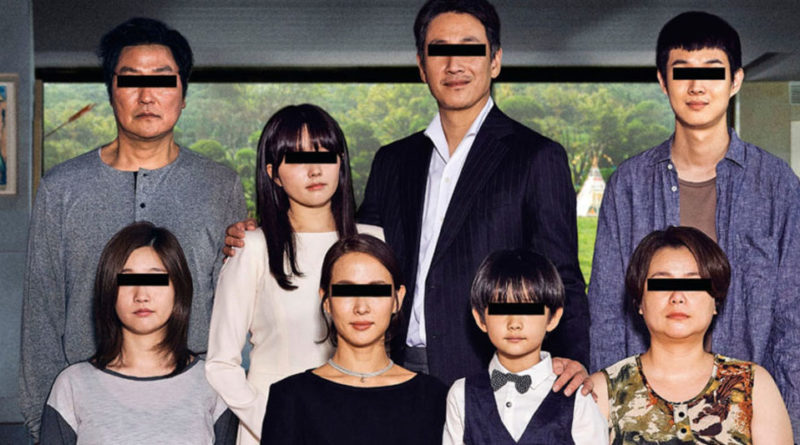
Bong Joon-ho’s Parasite (2019) is like the wild and crazy evil twin of Hirokazu Koreeda’s Shoplifters. While both films deal with a family in poverty who resort to extreme measures to survive, their cinematic methods are polar opposites. While Shoplifters is a quiet and subtle film, Parasite is a rapidly paced and boisterous dark comedy/thriller. Koreeda makes more introspective arthouse family dramas, while Joon-ho is a practitioner of more audience friendly genre films; this is reflected in the drastically different approaches to the topic of class inequality in Parasite and Shoplifters.
Parasite is about a financially struggling family of con artists who infiltrate themselves into the lives of a wealthy family. Joon-ho’s regular leading man Song Kang-ho plays Kim Ki-taek, the father of the con artists, while Jang Hye-jin, Park So-dam, and Choi Woo-shik play the mother, daughter, and son, respectively. Lee Sun-kyun and Cho Yeo-jeong play Park Dong-ik and Choi Yeon-gyo respectively, the easily manipulated father and mother of the wealthy family. Parasite is best enjoyed with less revealed about the plot details, but it is essentially about a power struggle between the con artist Ki-taek family and the prosperous Dong-ik family.
In a way, Parasite is like Luis Bunuel’s parodies of class warfare as directed by Quentin Tarantino, as it mixes social commentary with homages to popular genre tropes and scenes of almost cartoonish violence. This is both a strength of the film and a drawback, as Joon-ho’s attempts at creating a deeper social examination of class inequality are not as well executed as his action/suspense set pieces. As expertly crafted as the thriller and suspense aspects of Parasite are, where it falls short on are its attempts at social criticism and character development.
The characters in Parasite, from the destitute yet noble Kim Ki-tek to the wealthy but elitist Park Dong-ik and Choi Yeon-gyo, never reach anything beyond one dimensional caricatures. Also, the social critique and analysis of class warfare never penetrates deeper than surface level generalities of the wealthy taking advantage of those less fortunate than them. Parasite aspires to be both a mass entertainment thriller, while at the same time being an examination of societal divisions, but it doesn’t offer a more nuanced portrayal of this issue as Koreeda’s Shoplifters did.
Joon-ho wants us to feel justified outrage for the crass materialism and insensitivity of the wealthy class, but he does so in an overly obvious and heavy-handed manner. We see scenes of the Dong-ik family wallowing in their material wealth and looking down upon those outside their class, but everything in Parasite is portrayed in a black and white good versus evil level, without any shades of grey or ambiguity. In addition, because Joon-ho didn’t take the time to develop his performances beyond caricatures, we don’t have enough emotional investment to care about the characters for the last act of the film to work effectively. Instead, the conclusion of Parasite, which takes a turn into soap-operish drama, feels long and drawn out and wallows in sentimentality.
With that being said, where Parasite excels at is Joon-ho’s masterful handling of action and suspense scenes. As revealed in his previous films, Joon-ho is an expert at creating tension in elaborately designed set pieces; he does so through ingenious staging of the actors and their movement relative to camera placement and angles. This is best illustrated in a nerve wracking scene where three members of the Ki-tek family hide from the Dong-ik family under a table. Through clever use of dialogue and incisive blocking, Joon-ho creates a master class in ratcheting up tension in a set piece that would have made Alfred Hitchcock proud.
Parasite is a nearly great film that is prevented from being a masterpiece through its wobbly character development and strained attempts at social criticism. Joon-ho is still relatively early in his career, with only eight films completed thus far, so he still has time to develop and hone his craft as a filmmaker. Spielberg, who Joon-ho resembles in many ways, also took some time to find the right balance between expertly crafted action/thriller sequences and deep, incisive social critique, so Joon-ho needs to continue to develop as a filmmaker. Once he does master his art, I am sure we will be seeing some groundbreaking and innovative films from Joon-ho.
Monday, September 17, 2012
FILM REVIEW: THE SHOCK LABYRINTH
There are interesting differences between Asian horror films in terms of their countries of origin. Korean horror films tend to be more realistic and straightforward in tone, and focus more on real life thrills, such as serial killer/detective plots (I Saw the Devil, Tell Me Something). This can be attributed to Korean films being more mainstream in tone, as the Korean film industry is trying to establish a new Hollywood of sorts in the East, and want to make films that can compete with Hollywood on the global film market.
Southeast Asian horror films tend to focus on the supernatural realm, with films dealing with ghosts and hauntings (Shutter, Ghost of Mae Nak). This focus on the more supernatural realm of horror films can be attributed to the highly spiritual nature of Southeast Asian society; in many parts of Southeast Asia, such as Thailand and Indonesia, the realm of ghosts and spirits is intricately linked with the mundane realm of the real world.
Like the Overlook Hotel in Stanley Kubrick’s The Shining, the hospital in The Shock Labyrinth starts to take on an identity by itself, as it taps into the subconscious of each of the friends to dig up repressed memories of a tragic event that occurred in their collective childhood experience. As the title implies, the narrative of The Shock Labyrinth becomes labyrinthian in nature, as it weaves back and forth between violent and haunting memories of each of the main characters. The dark and frightening rooms and tunnels in the hospital become direct reflections of the primal fears of each character, and as the true identity of Yuki gradually reveals itself, the characters one by one descend into madness.
Southeast Asian horror films tend to focus on the supernatural realm, with films dealing with ghosts and hauntings (Shutter, Ghost of Mae Nak). This focus on the more supernatural realm of horror films can be attributed to the highly spiritual nature of Southeast Asian society; in many parts of Southeast Asia, such as Thailand and Indonesia, the realm of ghosts and spirits is intricately linked with the mundane realm of the real world.
Japanese horror films, on the other hand, are the most eccentric and original of all Asian horror films, as they frequently delve into the realm of the surreal and the absurd. This may be attributed to the very strict and disciplined nature of Japanese society, in which life is based on a series of orderly and long-engrained traditions of rules and rituals. Thus, the arts are a means of escaping from the rigid confines of Japanese society, and into a liberating realm of free-flowing creativity and taboo breaking, sometimes shocking displays of defiance.
The 2009 Japanese horror film The Shock Labyrinth is a perfect example of this rebellious, surreal aspect of Japanese arts. Directed by the prolific and successful Takashi Shimizu, best known for the Ju-on series of horror films, The Shock Labyrinth is a bold and chilling film. The Shock Labyrinth is reminiscent of the cult classic Japanese film Hausu, which was re-released by The Criterion Collection in 2010. Like Hausu, The Shock Labyrinth is a genre bending film that takes the horror film trope about a group of youth who find themselves in a haunted house, and elevates it to a surreal and outrageous level.
The Shock Labyrinth begins with a group of young friends who mysteriously encounter Yuki, a long lost friend who they thought had been dead for a long time. As the friends begin to question the true identity of Yuki, and some start to question their own sanity, Yuki has an accident, and they are forced to drive her to a hospital. The only hospital they find turns out to be deserted, and as they explore the hospital, dark, hidden secrets from the friends’ childhood start to emerge.
Like the Overlook Hotel in Stanley Kubrick’s The Shining, the hospital in The Shock Labyrinth starts to take on an identity by itself, as it taps into the subconscious of each of the friends to dig up repressed memories of a tragic event that occurred in their collective childhood experience. As the title implies, the narrative of The Shock Labyrinth becomes labyrinthian in nature, as it weaves back and forth between violent and haunting memories of each of the main characters. The dark and frightening rooms and tunnels in the hospital become direct reflections of the primal fears of each character, and as the true identity of Yuki gradually reveals itself, the characters one by one descend into madness.
Shimizu does a great job of throwing the audience into emotional turmoil, as his narrative gradually fragments into seemingly disconnected scenes of disturbing violence and bloodshed. Upon repeated viewings, the fragmentary scenes of the narrative gradually reveal themselves to be intricately connected, like a giant puzzle which can only be solved by the more patient and discerning players. What Shimizu is doing is cinematically portraying the true nature of a nightmare—how the seemingly random nature of our dreaming world has its own internal logic, one based upon the deeper matrix of the collective subconscious.
By gradually revealing more and more about the mystery of Yuki, Shimizu is also revealing the true nature of repressed memories. Oftentimes when a traumatic event occurs, our mind tends to repress memories of this event. These memories only come out when we are presented with a triggering mechanism to conjure them up. The triggering mechanism in The Shock Labyrinth is the hospital itself, which becomes a living, breathing monster that threatens to swallow up all of the main characters.
The Shock Labyrinth is a brilliant and frightening film that takes us on a wild ride into the realm of nightmares. Its narrative structure is psychologically sophisticated, and by the end of the film, the viewer is stuck in the deepest, darkest realms of the character’s horrific memories.
Subscribe to:
Posts (Atom)


