Showing posts with label Scorsese. Show all posts

Saturday, May 9, 2020

FILM REVIEW: ATLANTICS


Atlantics (2019) is a mysterious and beguiling film that completely draws the viewer into its hypnotic spell. Directed by the Senegalese/French filmmaker Mati Diop, the niece of the legendary Djibril Diop Mambéty, Atlantics begins as a love story that turns into something much more enigmatic and complex. Diop keeps revealing more layers of meaning and surprises as Atlantics progresses, culminating in a touching and powerful coda.

Set in the capital city of Dakar in Senegal, Atlantics is the story of Ada (Mame Bineta Sane), a young woman who is in love with Souleiman (Ibrahima Traoré), but is bethrothed to marry the wealthy Omar (Babacar Sylla). After Souleiman is unable to get paid for his work at a construction company, he resorts to the desperate measure of taking a boat with his coworkers to Spain to find employment. Without giving anything away, the risky boat trip sets into motion a series of mysterious and supernatural events for Ada and her seaside community.


By calling her protagonist Ada, Diop alludes to Jane Campion’s The Piano. Like Campion’s protagonist in The Piano, Ada in Atlantics is a strong-willed woman who engages in a forbidden love affair. Also like the protagonists in Campion’s Bright Star and Top of the Lake, Ada is forever seeking a way out of her restrictive, male-dominated society, and in the process define her own identity as a woman.

Another similarity to The Piano is the important role of the ocean and nature in Atlantics. Throughout the film, Diop focuses her camera on the vast and majestic Atlantic Ocean. For the characters in Atlantics, the ocean is both a symbol of escape, and also a harbinger of tragedy. Souleiman seeks a better future for himself by escaping across the ocean, while Ada views the ocean as something that traps her within her family and unwanted marriage. Throughout Atlantics, Diop reveals how confined Ada feels, by framing her through fences and other man-made barriers. Ada’s only form of solace is a night club where she regularly goes with her friends.


Diop’s use of color and sound creates both a comforting and at times threatening environment, mirroring Ada’s journey through the film. When Ada is at the club, she is bathed in an otherworldly green light, while we hear the powerful waves of the ocean in the background. Indeed, Diop regularly cuts to alternatingly calm and ominous shots of the ocean, depending on Ada’s situation. Diop is more interested in creating a certain mood and tone than telling a straightforward narrative, and she successfully envelopes the viewer in her visually poetic world. Cinema is a primarily visual medium, and Diop has a complete mastery over this aspect of film.


With Atlantics, Diop carefully weaves an enchanting and at times eerie tale of doomed love and female empowerment. Although Ada struggles against many outside forces which try to control her, the concluding shot of Atlantics shows Ada coming to a satisfying self-realization. Spirits and ghosts appear throughout Atlantics, doomed lovers reunite, family members and friends argue and reconcile with each other, and all this is masterfully crafted by Diop; she is truly an exciting and powerful talent to watch.


Thursday, January 2, 2020

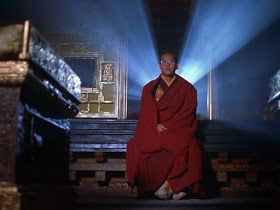
FILM REVIEW: KUNDUN


Martin Scorsese has always shown a deep reverence and appreciation for Asian cinema, as reflected in his championing of Asian auteurs like Edward Yang, Tian Zhuangzhuang, and Apichatpong Weerasethakul. Through his World Cinema Foundation, Scorsese has rescued and restored many important Asian films, including A Brighter Summer Day and The Housemaid. With Kundun (1997) Scorsese made his first Asian themed film, and the result is one of his emotionally resonant and moving films.

Kundun is a biopic about Tenzin Gyatso, the 14th Dalai Lama. The film explores the Dalai Lama’s life from his youth in Tibet up to his exile to India in 1959. Like Scorsese’s other spiritually themed films The Last Temptation of Christ and Silence, Kundun explores the topic of religious persecution. After the Communist government of China took over Tibet, atrocities against the Dalai Lama and his followers were committed, forcing the Dalai Lama to flee to India.

Throughout Kundun, Scorsese shows the struggles the Dalai Lama faced to maintain his practice of non-violent resistance. As the spiritual leader of his followers, the Dalai Lama has to protect his own people against the violent and oppressive actions of the Chinese invaders. Since the Dalai Lama obviously does not have access to a military or arms to defend himself, he tries at first to meet face to face with Mao Zedong to negotiate a peace deal.


This results in Mao furthering his prosecution of the Tibetan natives, and lecturing the Dalai Lama about how religion is poison. This is similar to the Japanese Inquisitor in Silence chastising Andrew Garfield’s Jesuit priest about how “the tree of Christianity withers in Japanese soil” because it has been poisoned. Indeed, both Kundun and Silence explore how peaceful protagonists confront and deal with oppressive, violent outside forces which view religion as something to be eliminated.

In a Scorsese gangster film, the protagonists naturally will counter violence with even more violent acts, resulting in a vicious circle of incessant death and destruction. Kundun is Scorsese’s first attempt to explore how one can fight violence with peaceful protest and compassion. Amidst the brutal oppression of his times, the Dalai Lama hopes that his example of compassionate resistance will result in peace.


We never see explicit depictions of the violence committed against the Tibetan people, except for one brief vision by the Dalai Lama of the corpses of his fellow monks. Instead, Scorsese fills Kundun with quiet but visually astounding imagery inspired by Buddhist philosophy, such as a breathtaking scene of an elaborate sand mandala being created and blown away. Kundun is an almost ethnographic exploration of the Dalai Lama’s culture, as Scorsese faithfully depicts the many rituals and traditions of the Tibetan people.

Throughout the film, Scorsese emphasizes the fragility of the Dalai Lama’s peaceful existence. The film’s earlier, more elegiac scenes of the Dalai Lama’s youth contrast with the more disruptive, frantic scenes of the Chinese army and government gradually infiltrating Tibet, such as an astonishing scene of the Chinese army marching ominously through the streets. This temporal nature of existence is emphasized throughout Kundun, as Scorsese is showing how life itself is transitory, and so are violence and suffering.


The last act of Kundun, as the Dalai Lama escapes to India, is an almost wordless sequence of events that depicts both the tragedy and ultimate hope of the Dalai Lama’s life. Just as he is about to cross the border into safety, he speaks these haunting words, “I think I am a reflection, like the moon on water. When you see me, and I try to be a good man, you see yourself.” Following the example of these words by the Dalai Lama, Scorsese emphasizes images of peace instead of violence in Kundun in the hopes of reflecting human nature’s deeper good.


Tuesday, November 26, 2019

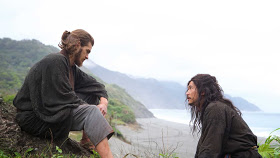
FILM REVIEW: SILENCE


Martin Scorsese struggled for decades to adapt Shusaku Endo's 1966 novel Silence into a film, and the result is a dark, brutal, and powerful masterpiece about a man's struggle with his faith, in the face of almost unbearable suffering and persecution. Although I am not a particularly religious person, what I connected with in Silence (2016) is its depiction of someone whose faith in a transcendent force guides his every thought and action. This force can be "Jesus," or "Buddha," or "Allah," but what Scorsese is trying to portray is a belief in a higher force that allows us to transcend the darker, more destructive side of human nature. 

Set in the 17th century, Silence is the story of a mission by Portuguese Jesuit priests Sebastiao Rodrigues (Andrew Garfield) and Francisco Garupe (Adam Driver) to find Father Cristovao Ferreira (Liam Neeson) in Japan, who has been rumored to have renounced his faith after being tortured.  Although they know that they are entering a country which at the time was targeting Christians with violent religious persecution, the two Jesuit priests nevertheless carry out their mission without hesitation.  In the process, the priests befriend a group of Japanese Christians, who practice their faith in secret under fear of being tortured and even killed.  Eventually, the two priests are captured by the Japanese, and Father Rodrigues' faith in a higher power is put to the ultimate test.

While the leads of Silence are the two Jesuit priests, Scorsese also gives equal time to the many Japanese actors in the film.  The standouts are Issey Ogata as the cruel and manipulative Inoue Masahige, Shinya Tsukamoto as the passionately devout Christian Mokichi, and Yosuke Kubozuka as the conniving and self-centered Kichijiro.  Shinya Tsukamoto gives a particularly powerful performance as a long-suffering Christian who is able to maintain his faith even under the cruelest forms of punishment.  Indeed, Silence is all about the struggle to maintain one's sanity and strength in the face of overwhelming brutality.  


Filmed in the verdant landscape of Taiwan, the natural scenery as shot by cinematographer Rodrigo Prieto is gorgeously rendered.  Scorsese contrasts the beauty of nature with the cruelty of the human world, and he doesn't flinch from showing us the bloody and brutal extents to which the Japanese inquisitors will go to torture and persecute the Jesuits priests and their fellow Japanese converts.  Silence continues Scorsese's examination of religious persecution, which he explored before in The Last Temptation of Christ and Kundun.  In this sense, Silence completes Scorsese's spiritual trilogy of films, with the connecting thread between the three films being a protagonist who struggles with keeping his faith in a world where the most atrocious and inhumane forms of destruction and violence exists.  

Although Silence is on its surface a religious film, its message of compassion for those who are suffering is a universal one.  Rodrigues is not only seeking to maintain his faith in a society that has outlawed it as a symbol of Western imperialism and control; he is ultimately seeking to transcend the cruelty and brutality of his time by not giving into his darker impulses to violently rebel against or physically attack those who are persecuting him.  Rodrigues is able to do this by never letting go of his faith in a higher power, which he views as a positive symbol of peace amidst a world filled with violence.  


Throughout the film, Rodrigues views his mission as one of bringing peace and love to those who are less fortunate than him; hence his willingness to take in the suffering Japanese villagers at the beginning of the film and allow them to practice their faith in peace.  If we take away the subject matter of Christianity and religion, we can also see Rodrigues as someone who views it as his life mission to be compassionate to all.

Indeed, throughout the film, Scorsese contrasts the more peaceful actions of Rodrigues with those of the inquisitors.  After one of the Japanese prisoners is horrifically beheaded for refusing to renounce his faith, Rodrigues gives forgiveness to another Japanese prisoner who is clearly a scoundrel and a liar.  Rodrigues sees the goodness in everyone as a guiding force in his life, while the inquisitors use violence and torture to maintain their worldview, much like the outlaw criminals in Scorsese's gangster films.


The use of physical forms of religious belief is displayed throughout Silence, in the form of Bressonian-like close-ups of hands in prayer, and various paintings and likenesses of Christ.  These physical manifestations of religious iconography are presented as forbidden symbols of spiritual expression in a wider society that forbids them.  Eventually, Rodrigues is forced to renounce his Christianity by stepping directly onto a likeness of Christ in an act of apostasy.  Interestingly enough, Rodrigues' struggles to communicate with God seem to stop after he steps on this physical form of religion.  Scorsese is showing how Rodrigues is finally able to transcend the outer realm of belief and internalize it into a deeper, spiritual inner world.  

Ultimately, Silence is a film about a man who struggles to maintain his faith in a benevolent, higher power amidst a world filled with death and destruction.  Scorsese shows us this struggle in masterfully directed scenes of betrayal and spiritual turmoil, but throughout Silence is a deep, unyielding belief in the goodness of humankind.  Without giving anything away, the last image of Silence shows Rodrigues literally holding onto a symbol of compassion and love, long after he has struggled with being able to outwardly reveal his faith in God. Scorsese's Silence shows us how even in the darkest of times, we should never let go of our better selves.  


Sunday, November 3, 2019

FILM REVIEW: THE IRISHMAN


Martin Scorsese’s The Irishman (2019) is a stunning and monumental achievement. It’s a late career masterpiece that caps off a sort of gangster trilogy that began with Goodfellas and Casino. While Goodfellas was about the youth and joy of the gangster lifestyle (albeit a joy tinged with the bitter reality of violence) and Casino was about the success of middle aged gangsters, The Irishman is about a gangster at the later stages of his life, reflecting on the destructive consequences of the death and wreckage he has left behind. Although the first hour and a half of The Irishman has the ironic joie de vivre of the gangster as outlaw on display in Goodfellas and Casino, the second half of The Irishman is a much more mournful portrait of an aging gangster trying to atone for his sins.

Scorsese’s The Irishman is based on Charles Brandt’s book “I Heard You Paint Houses,” which is the biography of the gangster Frank Sheeran.  Both the book and the film portray how Sheeran, played by Robert De Niro, ascends the ladder of organized crime to eventually work for the powerful labor union leader Jimmy Hoffa (played by Al Pacino) who has extensive dealings with the criminal underworld. Sheeran gets his start through a chance encounter with the powerful Italian gangster Russell Bufalino (played by Joe Pesci), who takes him under his wing and helps Sheeran along in his ascension up the ranks of the mafia.

What separates The Irishman from Scorsese’s earlier gangster films is its much broader social and political scope, as Sheeran’s dealings with organized crime bring him into contact with such powerful historical figures and events as the election and assassination of John F. Kennedy, the heated union disputes between Jimmy Hoffa and his rivals, and the attempted American coup of Fidel Castro’s Cuba during the Bay of Pigs invasion. This expanded range of context gives The Irishman a richer and more complex backdrop for Scorsese to explore how deeply intertwined the world of organized crime has been with all aspects of American life.


This deeper backdrop gives The Irishman an epic feel that allows the viewer to luxuriate in the almost novelistic texture of the narrative, which feels like classical literature at times. We as the viewer are as fully engulfed in the three and a half hour runtime of Scorsese’s elaborately designed cinematic canvas as we would be reading a 1000 plus page Leo Tolstoy historical novel.  The Irishman explores how history, on both a societal and personal level, can have tragic consequences on an individual’s life.

Indeed, the final hour of The Irishman feels almost like an Ingmar Bergman film, as Sheeran struggles to come to terms with his fading mortality, while at the same time reflecting on the many deaths he has brought on through his own actions. De Niro’s powerful performance, which is achieved largely through non-verbal physical cues, brings to weight the full tragedy of Sheeran’s life, culminating in a darkly funny scene where he goes shopping for his own coffin. 

The specter of death haunts almost every frame of The Irishman, from its opening scenes in a retirement home filled with aging and sick elders, to its many literal deaths brought on by the violent actions of its gangster characters. Scorsese is laying bare for us in a much more cold and brutal way than he did in Goodfellas and Casino the full destructive nature of the gangster lifestyle. Also, unlike in his earlier gangster films, Scorsese is not interested in fetishizing or glamorizing violence in The Irishman. In one memorable scene, two gangsters enter a barbershop as the camera pans along with them. Instead of showing the gangsters massacring their targets in the barbershop, Scorsese keeps the camera outside the store focused on a bouquet of flowers, as we hear screams and gunshots inside. With The Irishman, Scorsese is not interested in showing us violence; instead, he wants to show the destructive consequences of violence.


In Goodfellas and Casino, scenes of brutal violence were oftentimes counteracted by scenes of gangsters enjoying the fruits of their labor as if they were essentially a happy family unit of sorts. However, in The Irishman, there is no real family unit for Sheeran to fall back on or rely on for warmth and comfort.  

Instead, the substitute “family” unit of the gangsters in The Irishman are all portrayed as backstabbing and manipulative individuals who view Sheeran as only an instrument for them to use for their own means. Also, Sheeran’s actual biological family are equally cold and distant towards him; something which is justified due to the many murders he was responsible for. Sheeran realizes this near the end of his life, so the last part of the film deals with Sheeran’s attempts to reconcile with his biological family over his violent past.

It’s almost as if Scorsese, like Sheeran’s character, is atoning for what he perceives as his past “sins.” Scorsese has oftentimes, wrongly in my opinion, been accused of glorifying the gangster lifestyle through his films. While Goodfellas and Casino did sometimes portray gangsters as having at times glamorous lives, the films also ended by showing how ultimately empty these lives were.  The Irishman, with its more meditative and measured tone about gangsters, is Scorsese’s attempt to come to terms with his career, and reflecting on the results of his past work.  


Ultimately, what makes The Irishman such a powerful and important film is its message of redemption. Scorsese is asking us if we can forgive someone who has led a life of death and destruction, and if not, then what ultimately is it that makes us human?  Do even the most violent and seemingly immoral people have even a shred of humanity left in them? Perhaps, Scorsese is saying, we can strive to seek peace and redemption even among those who seem irredeemable. 

In the last act of The Irishman, Sheeran tries to make amends with his estranged daughters. The very fact that Sheeran is even trying to reunite with his family near the end of his life means that he himself sees the error of his ways, so he still has some humanity left. With The Irishman, Scorsese is telling us— if someone as seemingly unforgivable as Sheeran can find redemption and seek a more peaceful life, then so can we all.

Or, as Scorsese himself has said, “It seems to me that any sensible person must see that violence does not change the world and if it does, then only temporarily. And as I’ve gotten older, I’ve had more of a tendency to look for people who live by kindness, tolerance, compassion, a gentler way of looking at things.”