Tuesday, April 7, 2020

FILM REVIEW: A HIDDEN LIFE


Most war films celebrate the heroism of soldiers who fought for their nations, but Terrence Malick’s A Hidden Life (2019) is about a soldier who does the exact opposite. A Hidden Life is about a German soldier during World War II who refuses to join in the war efforts of the Nazi party. Like Malick’s previous films, A Hidden Life is ultimately an exploration of a man’s search for a deeper spiritual meaning in his life. The soldier in Malick’s film sees the darkness and brutality of Germany’s slide into Nazism, and tries to make sense of it through a deeper connection with God.

A Hidden Life is set in 1940s Germany and based on the true story of the conscientious objector Franz Jägerstätter (August Diehl) and his wife Fani (Valerie Pachner). As the film begins, Franz, Fani and their daughters live an idyllic and peaceful existence on their farm in the village of Radegund. However, the rise of Hitler and the Nazi party is still felt in the village, as evidenced by the patriotic Mayor (Karl Markovics) who constantly badgers Franz to join the war effort. Although Franz at first refuses to join the army, he eventually is drafted into the war effort. Franz leaves Radegund to prepare for battle, but he refuses to fight, leading to his imprisonment and torture.


A Hidden Life feels very much like the film that Malick has been working towards his whole career. Malick’s legendary status began in the 1970s when he burst into the cinematic landscape with two astonishingly accomplished films that heralded the arrival of a major talent. Malick then disappeared for almost two decades, and didn’t make another film again until 1999 with his World War II set epic The Thin Red Line. Malick then returned in 2005 with another historical period piece with The New World, followed up by The Tree of Life a few years later.

After The Tree of Life, Malick went on a filmmaking binge, with four films almost back to back from the years 2012 to 2017. Malick’s two previous historical epics The Thin Red Line and The New World were ambitious but flawed films that felt like a director who was re-learning the art of filmmaking after a long absence (indeed, as mentioned before, Malick hadn’t made a film for almost two decades before that point). While there were incredibly crafted scenes of spiritual and visceral beauty in these two films, they also felt meandering and muddled at points. The Tree of Life was a more structured and accomplished work than The Thin Red Line and The New World, but it also contained some jarring thematic detours that didn’t quite gel into an aesthetically coherent whole.

Then, Malick seemingly went off the deep end with his next three films To The Wonder, Knight of Cups, and Song To Song. Malick shot these three films without a script, and by all accounts the productions of the films were scatter shot and without focus. The films themselves were seemingly randomly improvised scenes strung together in post-production by druggy, sleepy voice-overs that sounded like hippies trapped in an endless time warp of the 1960s. While Malick’s usual thematic concerns about the search for God and meaning in a spirituality impoverished world were inherent within these films, they ultimately were too meandering and incoherent to function as satisfying works of art.


With A Hidden Life, Malick finally settled down and created a film with a tightly structured script and shooting schedule, and the result is Malick’s best film in years. In fact, A Hidden Life is as powerful as Ingmar Bergman’s Winter Light and Martin Scorsese’s Silence in its portrayal of spiritual struggle. Like these films, A Hidden Life is an emotionally devastating examination of the search for meaning in a cruel and indifferent world. As Franz wrestles with his belief in a higher power while his Nazi captors endlessly torture him, Malick’s film reminds one of St. John of the Cross’ 16th century poem The Dark Night of the Soul.


By basing A Hidden Life on a true story, and setting it in confined locations, Malick is able to focus his skills in a more effective manner than his previously unstructured films. The scenes of religious and spiritual torment no longer feel out of place as they did in To The Wonder, which awkwardly cut back and forth between Javier Bardem’s tormented priest and Ben Affleck’s search to constantly get laid. Indeed, the cumulative impact of Franz’s journey to find God culminates in an emotionally devastating last act.


Malick poetically contrasts the bucolic and pastoral natural beauty of Franz’s village of Radegund with the dark and grimy Nazi prisons where Franz is imprisoned. In this sense, Malick is pointing us forward as a species towards the almost Eden-like existence of Franz and Fran and their peaceful connection with nature (much like how Malick portrayed indigenous tribes in The Thin Red Line and Native Americans in The New World). In a way, Malick’s films function as a time capsule for how we can co-exist peacefully, and A Hidden Life is his purest expression of this. A Hidden Life is not only a portrait of the horrors of Nazi Germany, but also a stirring and powerful reminder of the goodness of the human spirit amidst unspeakable cruelty.


Friday, March 27, 2020

FILM REVIEW: DOMAINS


Domains (2019), directed by Natsuka Kusano, is an innovative and startling examination of the nature of performance in cinema. A single plot summary would not encompass the many ways in which Kusano dissects the multiple layers of the cinematic medium in her groundbreaking film. Domains is about the various degrees of truth and perception which film can explore. Do we see a film to uncover simply plot details, or should we explore deeper by seeing how cinema can change our perspectives as viewers? Kusano examines questions like these, and many more, in Domains.

As the film opens, the lead character Aki (Shibuya Asami) is confessing her part in the murder of the daughter of her close friend to a police investigator. At first, we think Domains is going to be a police procedural about what led Aki to commit this shocking crime. In a way, Domains is an investigation into what would drive someone to commit murder, but it does so in a completely unexpected manner. After the opening interrogation scene, the rest of Domains consists of rehearsal scenes for a separate film about the events leading up to the murder. The three main characters in these rehearsals are Aki, her close friend Nodoka (Kasajima Tomo), and her friend’s unnamed husband (Tomo Kasajima).


The rehearsals play out for the most part in real time, and it’s interesting to see how Kusano films the same scenes multiple times in varying perspectives to reveal how a simple change of tone or rephrasing of a line of dialogue can alter the whole meaning of each scene. In this way, Kusano is exploring the elasticity of cinema, and how it can be used to distort viewers’ perspectives of cinematic truth. Jacques Rivette also explored this same free flowing nature of film in his magnum opus Out 1, which similarly consisted of many scenes of actors rehearsing.

Both Kusano and Rivette are showing how cinema by its very nature is something that is being manipulated not only by the director, but also by the actors who bring their own truths to cinema. Aki tries to make sense of her motivations for murder by turning her actions into a filmic performance piece for an audience. By doing so, the actress playing Aki, along with her two acting collaborators, have just as much power over the construction of Domains as the director Kusano does.


However, this power is not simply one of actors using their skills to elicit emotion from the viewer as in a traditional film. Instead, by revealing how all of Domains is essentially a transparently theatrical experience, Kusano and her actors are giving power back to the viewer to create their own interpretations of what they are seeing on screen. It is never made clear if Aki actually committed the murder she confesses to at the opening of the film, or if the murder is just a fictional aspect of the film Aki is rehearsing for.

Kusano wants to reveal those elements of cinema which are traditionally hidden from viewers. Not only does she show us rehearsals of scenes, but Kusano also draws attention to the camera itself, as in one scene where the camera purposefully pulls back from the actors in a disruptive and obvious manner. In another scene, we clearly see the reflection of the camera in a mirror, and several times throughout the film we hear someone yelling “cut,” or we see the slate being used. Alejandro Jodorowsky similarly ended Holy Mountain by panning out to reveal a film set, but Kusano takes this further by hiding almost nothing from the viewer.


Ultimately, Kusano is trying to make a more active form of cinema where the audience has to fully engage with what they are seeing on screen. Kusano is breaking apart the artificially of film, and forcing viewers to come to their own interpretations. Like the character of Aki, one views Domains as a form of constant rehearsal to re-wire how we view cinema. There is no longer one form of cinematic truth dominated by Hollywood films whose sole function is to manipulate viewers into feeling pre-determined emotions and perspectives. Instead, Kusano and other filmmakers like her are pointing us towards a more empowering and liberating form of cinematic engagement.


Thursday, March 12, 2020

FILM REVIEW: THE CHRYSANTHEMUM AND THE GUILLOTINE


The Chrysanthemum and the Guillotine (2018) is an eccentric and moving epic film about Japanese women sumo wrestlers and socialist anarchists. Directed by the prolific Takahisa Zeze, who started out making soft core pink films, The Chrysanthemum and the Guillotine is unlike any historical epic you have ever seen. Although it is based on real historical events, Zeze infuses the film with surrealistic touches and characters that seem to exist in a parallel universe.

Set shortly after the Great Kanto earthquake of 1923, The Chrysanthemum and the Guillotine tells the dual stories of a female sumo wrestling troupe and a group of socialist anarchists. The anarchists regularly plot assassination attempts and other violent acts to get their revolutionary messages out. Two members of the anarchist group, Tetsu (Masahiro Higashide) and Daijiro (Kanichiro), befriend two members of the wrestling troupe, Tomoyo (Mai Kiryu) and Tamae (Hanae Kan).  Their lives become disrupted by a group of former World War One veterans led by Daigoro (Shima Ohnishi), who continuously try to shut down the troupe’s performances because they view them as subversive.


This plot summary only hints at the unique vision and structure of Zeze’s film. From the beginning to the end of the film, Zeze has his actors perform at an heightened emotional state; this is clearly not a Yasujiro Ozu film. In this way, Zeze’s performances resemble the almost trance-like hysteria of the actors in the films of Andrzej Zulawski and Sion Sono. There are also many quiet and more subdued moments in the film, but they serve only as momentary breaks before the next wave of grand emotion hits. 

Although at times this tone can be exhausting, especially at the film’s epic length of 189 minutes, it all leads to a climactic showdown between the sumo wrestlers and the military that is unlike anything you have ever seen. This frantic tone of the film is very much a reflection of the youthful exuberance and energy of Zeze’s characters. Revolutionary activity is the province of the idealism of youth, a concept which Zeze explores in his film.

Thematically, The Chrysanthemum and the Guillotine is a neo-feminist defense of female empowerment, although not in an overly obvious Hollywood manner. Many of the members of the women sumo wrestling troupe have escaped from oppressive marriages, and find solace in a sisterhood of strong women whose very existence is a statement against the traditionally male world of sumo wrestling. 


When the troupe gives their first performance, the male members of the audience mock them and hope to see them wrestle nude. However, the troupe is able to win over the male spectators with their skill as professional sumo wrestlers. Soon, the troupe becomes a mini-sensation in the many villages they visit, which draws the ire of the group of war veterans, who find any opportunity they can to harass the troupe.

Zeze contrasts the discipline and skill of the female wrestling troupe with the dysfunctional all male socialist anarchist group. Unlike the sumo troupe, the anarchist group is in a constant state of disarray. They carry out bungled assassination attempts, and are never able to draw the wider public to their socialist utopian ideals. Instead, Zeze reveals that many members of the male anarchists group are more interested in sleeping with prostitutes then actually carrying out revolutionary acts. This is a direct foil to the success and determination of the female wrestling troupe.


Ultimately, The Chrysanthemum and the Guillotine is about outcasts from society who are able to successfully form their own unique society of sorts. The female wrestling troupe becomes a respite for their members from the overly oppressive and controlling nature of the wider society. The film’s exploration of the battle between the wrestling troupe and the outside forces that threaten to break it apart is cinematically liberating and exhilarating.


Monday, March 2, 2020

FILM REVIEW: A TIGER IN WINTER


A Tiger in Winter (2017) is a beguiling and incisive portrait of the artistic process of writing. The practice of writing is a solitary and not exactly cinematically dynamic process, but with A Tiger in Winter, Lee Kwang-kuk is able to really get at the essence of the struggling artist. Lee is not necessarily concerned with the actual ritual of writing, but with the writer’s inability to fit into society and function as others do. By focusing on the dysfunctional life of an artist, A Tiger in Winter offers an often bitterly funny view of the creative life.

Lee Kwang-kuk was formerly an assistant director for the celebrated Korean filmmaker Hong Sang-soo. Indeed, Hong Sang-soo’s influence is strongly felt in A Tiger in Winter, with its long, seemingly improvised scenes of uninterrupted dialogue, and its focus on male/female relationships. Like the films of Hong Sang-soo, A Tiger in Winter is about a man who is unable to commit to the women in his life.


The protagonist of A Tiger in Winter is Gyeong-yu (Lee Jin-wook), a struggling writer who leaves his girlfriend and proceeds to wander around aimlessly until he meets his ex-girlfriend Yoo-jung (Go Hyun-jung). Unlike Gyeong-yu, Yoo-jung is a celebrated writer, but her chronic alcoholism prevents her from meeting her publisher’s deadline to complete her next collection of short stories. A Tiger in Winter is about Gyeong-yu and Yoo-jung’s attempts to reconcile their former relationship, while both of them struggle to fulfill their personal and artistic needs.


While the influence of Hong Sang-soo is felt throughout A Tiger in Winter, Lee Kwang-kuk is also a much more visually poetic director than Hong. While Hong is primarily interested in using cinema to explore the relationships dynamics between women and men, Lee’s aesthetic concerns are more oriented towards the visual palette and symbolism. The title of the film itself refers to an actual tiger that has escaped from the zoo, and this tiger is symbolically portrayed by the two main protagonists. Like tigers who are away from captivity, both Yoo-jung and Gyeong-yu are self-destructive forces of nature that devour all those around them.

Yoo-jung is constantly taking advantage of those closest to her, including Gyeong-yu, to fulfill her needs, whether they be her physical needs (through her addiction to sex and alcohol), as well as her needs to be recognized as a celebrated author. Gyeong-yu also manipulates his friends and loved ones to fulfill his selfish desires to remain constantly aloof from commitment; he does so because he believes it will benefit his artistic process as a writer. Throughout the film, Lee explores how his two protagonists destroy those closest to them, like wild tigers escaped from captivity. Near the end of the film, Lee also reveals what appears to be imaginary glimpses of the actual escaped tiger, adding an element of visual surrealism to his mise-en-scene.


There are many delightfully odd moments in A Tiger in Winter, such as when Yoo-jung drunkenly peels some tangerines and places them in a haphazard pile on a table, without eating them, or when Gyeong-yu keeps meeting passengers on his driving route who refuse to pay him. These little moments reveal the eccentric nature of artists, which is what A Tiger in Winter is ultimately about. Lee wants to show us the private, interior lives of real artists, both those who struggle to be discovered, and those whose fame and career may be built upon dubious means.  It will be interesting to see how Lee further develops his talents as an artist himself, and we are all captive spectators to his intriguing work.


Friday, February 21, 2020

FILM REVIEW: HARMONIUM


Like the musical instrument that it references, Kōji Fukada’s Harmonium (2016) is methodical, meticulously constructed, and subtly disturbing. It reminds one of a Hitchcock thriller mixed with a hard boiled Sam Spade film noir. The less said about the plot specifics the better, as part of the enjoyment of viewing Harmonium is seeing how Fukada masterfully peels apart layers upon layers of the plot to uncover a deeply unsettling story.

Harmonium is about a seemingly normal Japanese family, consisting of a hard-working and stoic father (Toshio played by Kanji Furutachi), his wife (Akie played by Mariko Tsutsui), and their daughter (Hotaru played by Momone Shinokawa and Kana Mahiro). This three family unit live a quiet and mundane life until Toshio’s friend Yasaka (Tadanobu Asano) shows up, freshly released from prison. At first, Yasaka seems like a harmless and even gentle person, as he carefully ingratiates himself into Toshio’s family life. However, as Harmonium progresses, Fukada slowly shows how the family gets destroyed from Yasaka’s appearance.


On the surface, Harmonium is a domestic drama about a father and mother trying to protect their family from harmful, outside forces. But, Fukada is more interested in exploring how seemingly normal people such as Toshio are able to hide secrets about themselves from their closest loved ones. Without giving anything specific away, Toshio’s connections with his friend Yasaka’s criminal behavior are closely intertwined, and threaten to completely tear the central family unit apart.


The chain reaction of events that slowly destroys the family unravels in a slow, calculating manner, like an avalanche gaining force until it finally demolishes everything in its sight. The first half of Harmonium deals with Yasaka trying to gain the trust of Toshio’s wife and daughter, becoming an almost father figure of sorts to replace the cold and distant Toshio. A shocking event occurs midway through the film which causes Toshio to break out of his shell, and to take on a stronger role in the care of his wife and daughter. But, by that point it’s too late, as Fukada wants to show how Yasaka and Toshio are closer in nature than we first expect.


This ultimately is what Harmonium is about— the duplicitous nature of men who try to lead normal lives, while trying to hide disturbing truths about themselves from those they love. In this way, Harmonium is similar to Scorsese’s The Irishman, which is also about a man trying to reconcile his darker side with his duties to protect and love his family. Kanji Furutachi gives a chilling performance as Toshio, masterfully portraying how his stoic nature hides a deeper, more disturbing nature. As his wife, Mariko Tsutsui also gives a strong performance as a mother who will do anything to protect her daughter from both Yasaka and Toshio.


Harmonium gradually and inevitably leads to a genuinely shocking conclusion that confronts the viewer with questions about the true nature of the family unit. Fukada neatly connects an earlier image in the film of Toshio’s family happily lying by the lake with a more disturbing parallel image of the same family unit lying by the same lake later in the film, but in much more devastating circumstances. Like the best thrillers, Harmonium trusts its audience to patiently go along with its slow but steady flow, and asks us to look deeper into both ourselves and those around us to uncover deeper, darker truths about human nature.


Sunday, February 16, 2020

INTERVIEW: EDMUND YEO


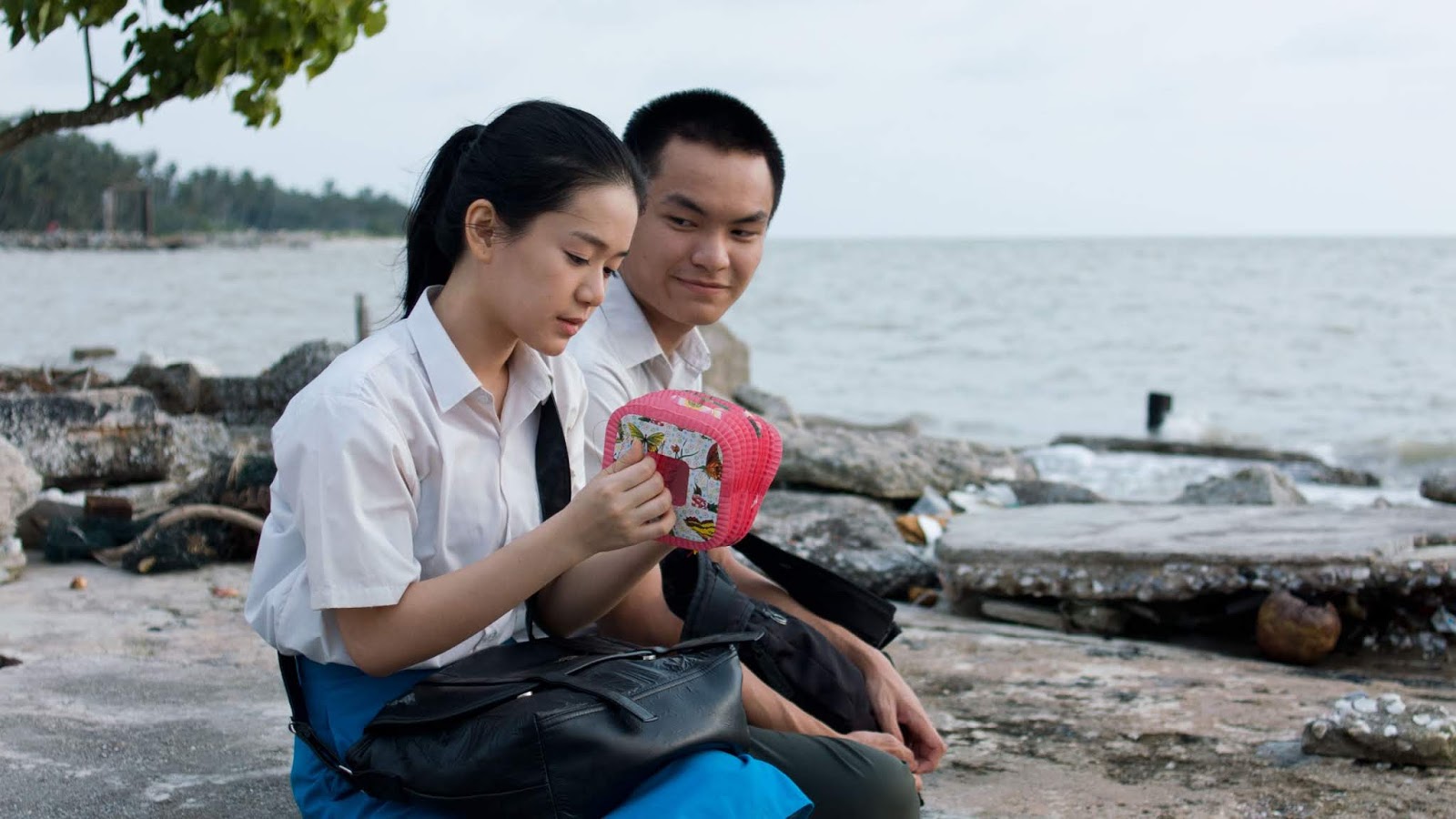
The debut feature length film of Edmund Yeo, River of Exploding Durians, became the first Malaysian film to compete at the Tokyo International Film Festival in 2014. The film was an astonishingly assured debut that used poetic imagery and aesthetically innovative techniques to examine the effects of a rare earth plant on the residents of a seaside village. In this interview, I discuss the making of River of Exploding Durians with Edmund Yeo, as well as his cinematic influences.


River of Burning Durians felt like a very epic film, in terms of the scope of the story and the topics it covers. Can you talk a bit about how long it took you to shoot the film?

The film was shot in 17 days, but in a span of two months. Due to the structure of the film and the schedules of the actors, the shoot was mostly divided into different blocks; three to four days for the Ming/Mei Ann love story, a break during the Chinese New Year, then shooting another seven to eight days for the Teacher Lim/Hui Ling's story, spending another two to three days at the Cameron Highlands so we could shoot in the mountains and the tea plantation for the final block of the film, and so forth. We worked with a very low budget so we didn't have the luxury to shoot too much nor shoot too long.


I noticed, especially in terms of the flow of the narrative and the political revolutionary student recreation scenes, some homages to Edward Yang and even the French New Wave. Can you tell us about your influences for the film?

Thanks. You have definitely mentioned some of my deepest cinematic influences for this film, along with Hou Hsiao-Hsien and Tarkovsky. I didn't consciously try to make a film similar to these masters. But I often watch and rewatch their works to study and contemplate. Due to the profound love I have for their works, it's probably inevitable that, instinctively, the filmmaking grammar and storytelling techniques I used were influenced by them! I was also doing my own Hou Hsiao-Hsien marathon shortly before the shoot, absorbing his masterworks like CIty of Sadness, Good Man Good Woman, Dust in the Wind, and The Time To Live and the Time To Die, so I was probably in a Hou Hsiao-Hsien phase during the shoot.


The acting all across the board was excellent. How were you able to get some of the leads into your film, and how was it like working with them?

I love working with actors, and also give them space to inhabit or embody their own characters so that we can all surprise ourselves with things we never visualized in the script. I take a very spontaneous approach when I shoot. I don't really work with storyboards because I prefer to figure out the compositions and the blocking when I'm on the set with my cinematographer and actors. So it becomes a very open process where everyone gets to discuss their ideas and such.

Among the actors playing the three young main characters, only Joey Leong (who plays Mei Ann) has a long experience in acting. Joey started out as a child actress, and despite her young age, she had an old soul because she had been in the industry for so long, I thought she was very suitable as Mei Ann. 

The other two, Koe Shern (Ming) and Daphne Low (Hui Ling) were relatively newcomers. Koe Shern was about to start college, but he had some acting experience when he was a kid. Daphne, on the other hand, I've known her earlier because we worked together in a previous short film of mine. She was actually the first person to join this project. At that time she was a part-time model with some minor roles in some local TV sitcoms. 

Because our industry is really small, all three of them knew each other long before the shoot. So even though I only had one to two days to rehearse, they were able to convey a feeling of familiary among themselves. 

Casting Teacher Lim was very tricky. I first approached a few local Malaysian actresses whom I thought were suitable for the role, but they had to turn me down despite their interest in the script. The subject matter was touchy and they knew the film would not pass the local censors. Also, they could risk getting into trouble with the government. I could empathize with their fears, it is what it is. A few local actors have lost job opportunities and their whole careers for being critical towards authorities. 

At that time, during my struggles to find someone to play Teacher Lim, I have already shot some parts of the film. One evening, I spoke to a Taiwanese producer friend of mine about my frustration, and he gave me the idea of actually casting a Taiwanese actress for the role.

The Taiwanese and the Malaysian Chinese have rather similar accents, so it wouldn't be improbable to cast a Taiwanese actress in a Malaysian role.

The name Zhu Zhi-Ying popped up during my discussion with my friend. I had seen her in Ang Lee's Lust, Caution, and also my friend Jay Chern's Golden Horse-winning short film Thief. So I immediately contacted her via Facebook, and to my disbelief, she replied almost immediately! We spent the night discussing the role, the film and somehow, the works of Yukio Mishima too. The next day, she said yes.

Having Zhi-Ying on the set was great, especially during the classroom scenes. I guess there was a feeling of freshness and slight intimidation because she was a foreign actress. So the kids playing the students were literally treating her like their teacher.


Were any elements of the story based on or inspired by real life events? I’m wondering specifically about the story of the revolutionary teacher Ms. Lim, and the construction of the rare earth plant.

The construction of the rare earth plant was based on real life events. It's an ongoing controversy that remains until this very day. The rare earth plant was built near a coastal village and it generated a lot of protests and anger due to the risk of radiation and such. 

The anger was justified. We had a similar case in the 1980s when a rare earth plant caused lasting damages upon the residents of the nearby town during its operations. It was a national tragedy.

Yet we wondered how could the authorities allow another construction of rare earth plant in the country, whilst disregarding the well-being of the people who live around the area. It's another case of capitalism being our king.


The country of Malaysia was portrayed very vividly in the film, both on a visual and auditory level. Can you talk about how this film was specific to Malaysia in terms of the themes and plot?

Using the aforementioned events as a backdrop, I constructed a fictional story of Malaysians and Malaysia at that particular moment in history. When protesters were not allowed to protest, when the State-controlled mainstream media would function as mere propaganda for the government, when young Malaysians were constantly hoping to leave the country for a better life. Many Malaysian Chinese of my generation grew up with parents who wanted us to leave the country when we could.

I also wanted to question the public education system, which were seldom improved upon over the decades. Generations of Malaysians were taught to be obedient, were taught that academic results were more important than anything else, but they were never taught to ask questions, nor taught to appreciate art and culture, and most importantly, we weren't taught to have empathy. All we had to do was to score As for exams and the school will tell us that we'll have a bright future ahead of us.

The four main characters in my film were extensions of myself. I think the high school students in my films reflected my frustrations during my teens, while Teacher Lim, who was closer to me in age when I was shooting the film, embodied my more recent concerns.


I noticed that the film seemed to be separated into two specific halves, with the first half being about the love story between Ming and Mei Ann, and the second half focusing on Ms. Lim and Hui Ling, and her attempts to start a revolutionary protest movement. How did you go about with structuring the film in these two halves, and was it challenging to put them together for you?


I like to take a more novelistic approach in developing and telling my stories. For Durians, I wanted to tell fragments of stories, from different character perspectives, so that gradually, as the film unfolds, you can put the larger picture together. 

In a way I liked defying expectations. What seemed like an innocuous coming-of-age teen love story gradually becomes a gateway into the darker aspects of our nation. The subjugation of history, the insidious intellectual repression, and so forth.

While I left a lot of blanks in my script for actors to improvise, and also experimented a lot when I was editing, I ended up being quite faithful towards the original structure I've developed. 

I was also trying to tell the beginning of a love story, but the beginning happened only at the end of the film, with the two characters you weren't expecting.


What for you was the significance of portraying the Chinese Lunar New Year Festival at the end of the film?

Chinese Lunar New Year has always been a time of joy and reconnection with friends and family. You contemplate what you have gone through, while hoping for a better future. Coincidentally, I shot the film around the Chinese Lunar New Year period, so I integrated it into my ending as a last-minute decision. I thought that would be the perfect time for my two protagonists, who had endured so much during the film, to meet. It was the first feature film I've ever made, so I wanted to end it with a sense of hope. 


Can you talk about any current or future projects you are working on?

I finished River of Exploding Durians in 2014.  Three years later I made my follow-up feature, Aqerat (We, the Dead).  I'm now finishing up my new film Malu (which means 'Ashamed' in Malay), the film is a decades-spanning family saga set in Malaysia and Japan, with a cast and crew from both countries. It's also an intimate project that I've shot on and off over the span of two years. I will premiere it this year.

I'm also writing the screenplay for the film adaptation of a novella by a well-known Japanese novelist. I'm still rather early in development for that one, but hopefully I'll be shooting the film late this year in Tokyo, after the Olympics!


Monday, February 3, 2020

FILM REVIEW: MAGGIE


Some debut films safely follow traditions set before them, and serve as nothing more than calling cards for making the next big budget Hollywood blockbuster movie. The Korean film Maggie (2018) from Yi Ok-seop, definitely does not fall into that category. Instead, Maggie is an utterly unique and delightfully strange film that seems to exist in a parallel dimension; one that we would all like to visit and enjoy as a respite from the mundane world of studio filmmaking.

The less revealed about the plot the better, as part of the thrill of viewing Maggie is discovering the many new ways Yi Ok-seop plays with traditional narrative structure and the film form. In fact, to even attempt to provide a traditional plot summary of Maggie would ruin the many surprises inherent within the film. However, for the sake of clarity, Maggie is about the wondrous and eccentric chain of events that occur to a young nurse (Yoon-Young, played by Lee Joo-Young), her boss (Lee Kyung-Jin, played by Moon So-Ri), and her boyfriend (Sung-Won, played by Koo Gyo-Hwan) after a compromising X-ray photo of a couple having sex surfaces at the hospital the nurse works at. 


What makes Maggie such an original vision is its complete absurdist disregard for the traditional three act structure of narrative filmmaking. Instead, Maggie freely floats in an almost stream of consciousness manner between the parallel and interconnecting lives of its three main characters. What unites the three characters together are a psychic fish named Maggie and her ability to form sinkholes throughout South Korea. Yi Ok-seop masterfully weaves these various storylines together to create a surreal tapestry of young love (through the relationship of Nurse Yoon-Young and Sung-Won) and unresolved regret (through the story of Lee Kyung-Jin), all observed omnisciently by the all-knowing fish Maggie.


What is the significance of this fish? Maggie the fish serves both as the narrator of the film, and also as a sort of God-like figure that is constantly guiding the lives of the three main characters. Employing the use of constantly changing interior monologues and perspectives in both human and sometimes non-human form, as well as camera angles and mise-en-scene that are slightly askew from the norm, Yi Ok-seop creates a free flowing use of cinematic techniques that truly liberates the medium. In one of the most amazing sequences in Maggie, Yi Ok-seop daringly cuts back and forth between Yoon-Young and Sung-Won as they breathlessly try to meet each other to secure a rental agreement, culminating in a shot on top of a flight of stairs that leaves the viewer in genuine shock. In another inventive sequence, Lee Kyung-Jin and Yoon-Young try to determine the veracity of their co-workers at the hospital with a game of darts using syringes.


Throughout the film, Yi Ok-seop symbolically explores the concept of falling into pits, both literally through the sinkholes that are seemingly controlled by Maggie the fish, and the subconscious holes that the characters find themselves falling into. Nurse Yoon-Young becomes obsessed with finding out if her boyfriend is capable of violence after she learns from his ex that he may have hit her at one time. Lee Kyung-Jin can’t escape the memory of a traumatic childhood event that still affects her adult life on a personal and professional level. Sung-Won starts to suspect his co-workers of theft and deception after he loses a ring that Yoon-Young gave him. Maggie explores how each of these characters struggle to dig themselves out of the subconscious pits they have fallen into, leading to a surprising climax that neatly ties together Yi Ok-seop absurdist vision.


In an era where so many filmmakers start their careers off with routine, mundane films whose sole purpose is to impress the gatekeepers of the traditional Hollywood studio film machine, it’s refreshing to see a debut film like Maggie which unapologetically adheres to its own unique worldview.  Although Yi Ok-seop is influenced by masters of surrealism like Dali, Bunuel, and Maya Dern, at the same time she has created a personal vision that heralds the arrival of a new voice in cinema. We need more debut films like Maggie to move the language of film forward, and remind us of the many joyful possibilities within the medium that still are waiting to be discovered.